---
title: "Landing Pages vs Websites: What Drives Higher Conversion?"
description: Learn the difference between landing page vs website conversion and when to use each to improve performance, increase ROI, and optimize results.
image: https://blogs.proiq.com/hubfs/landing-pages-vs-websites-conversion.png
---
- [ info@proiq.com](mailto:info@proiq.com)
- [](https://www.facebook.com/ProIQAdvisory) [](https://www.linkedin.com/company/proiq-advisory/) [](https://proiq.com/feed/)
[ ](https://blogs.proiq.com)
[](https://blogs.proiq.com/landing-page-vs-website#tmpmodule_1568761248550301)
- [Home](https://proiq.com/)
- Solutions
- [Recruitment Marketing](https://proiq.com/recruitment-marketing-solutions/)
- [Employer Branding](https://proiq.com/recruitment-marketing-solutions/employer-branding/)
- [Social Media Recruiting](https://proiq.com/recruitment-marketing-solutions/social-media-recruiting/)
- [Geofencing Recruiting](https://proiq.com/recruitment-marketing-solutions/geofencing-recruiting/)
- [Programmatic Job Advertising](https://proiq.com/recruitment-marketing-solutions/programmatic-job-advertising/)
- [Digital Marketing](https://proiq.com/digital-marketing-solutions/)
- [Search Engine Optimization (SEO)](https://proiq.com/digital-marketing-solutions/seo-services/)
- [Pay Per Click (PPC)](https://proiq.com/digital-marketing-solutions/ppc-services/)
- [Content Marketing](https://proiq.com/digital-marketing-solutions/content-marketing/)
- [Social Media Marketing](https://proiq.com/digital-marketing-solutions/social-media-marketing/)
- [Web Design & Development](https://proiq.com/digital-marketing-solutions/web-design-and-development/)
- [Portfolio](https://proiq.com/client-portfolio/)
- [Insights](https://blogs.proiq.com)
- About
- [About ProIQ](https://proiq.com/about-proiq/)
- [ProIQ Team](https://proiq.com/about-proiq/#ProIQTeam)
- [Technology Partnerships](https://proiq.com/about-proiq/#technology-partnerships)
- [Contact](https://proiq.com/contact-us/)
###### 9 min read
# [Landing Pages vs Websites: What Actually Drives Conversion](https://blogs.proiq.com/landing-page-vs-website)
By [ProIQ](https://blogs.proiq.com/author/proiq) on Apr 15 , 2026
###### Topics: [Website Design & Development](https://blogs.proiq.com/topic/website-design-development)
A common issue we see in digital marketing is simple but expensive: companies send traffic to the wrong type of page. These mistakes lead to lower conversion rates, higher acquisition costs, and underperforming campaigns.
While many teams debate landing pages vs websites, a better approach is understanding when to use each and how that decision directly impacts conversion performance.
In this guide, ProIQ’s marketing specialists will break down the difference between landing pages and websites and explain how each plays a distinct role in an effective digital ecosystem.
Most conversion problems don’t come from traffic quality. They come from sending the right audience to the wrong page type.
## Key Takeaways
- Websites are built for exploration, navigation, and brand discovery.
- Landing pages are intended to turn visitors into leads or customers.
- Sending high-intent traffic to the wrong page structure significantly reduces conversion rates.
- Campaign performance is directly tied to message alignment between the ad and the destination page.
- The highest ROI comes from using both websites and landing pages strategically together.
## What Is a Website?
A website is a multi-page digital presence designed to represent a company as a whole. It provides structure, depth, and navigation for users who want to explore, compare, and understand your business.
The primary purposes of a website are:
- Brand storytelling and credibility
- Catalog of services, industries, or resources
- SEO visibility across a broad range of keywords
- Informational discovery rather than immediate action
In most cases, a website serves as the central hub of your brand’s digital identity. Users arrive through search engines, referrals, or direct traffic and move through different pages as they gather information.
However, because websites are built for flexibility and exploration, they can present obstacles when the goal is fast conversion.
For companies focused on improving performance, structure matters. That’s why we often emphasize principles that support [website design that converts](https://blogs.proiq.com/website-design-that-converts) because not all website traffic behaves the same way, and design must reflect intent.
## What Is a Landing Page?
A landing page is a standalone page designed with the single, focused objective of converting leads.
Unlike a website, a landing page removes distractions, including unnecessary navigation, competing messages, and secondary goals. Everything on the page is intentionally built to guide the user toward a single action, such as:
- Filling out a lead form
- Booking a consultation
- Signing up for a service
- Downloading a resource
- Completing a purchase
Landing pages are built for decision-making moments, not exploration. They align tightly with a specific campaign, audience segment, or offer.
We’ve seen landing pages outperform general website pages simply because they eliminate choice overload. When users are given one clear path, they are much more likely to follow it.
## Landing Pages vs Websites: Key Differences
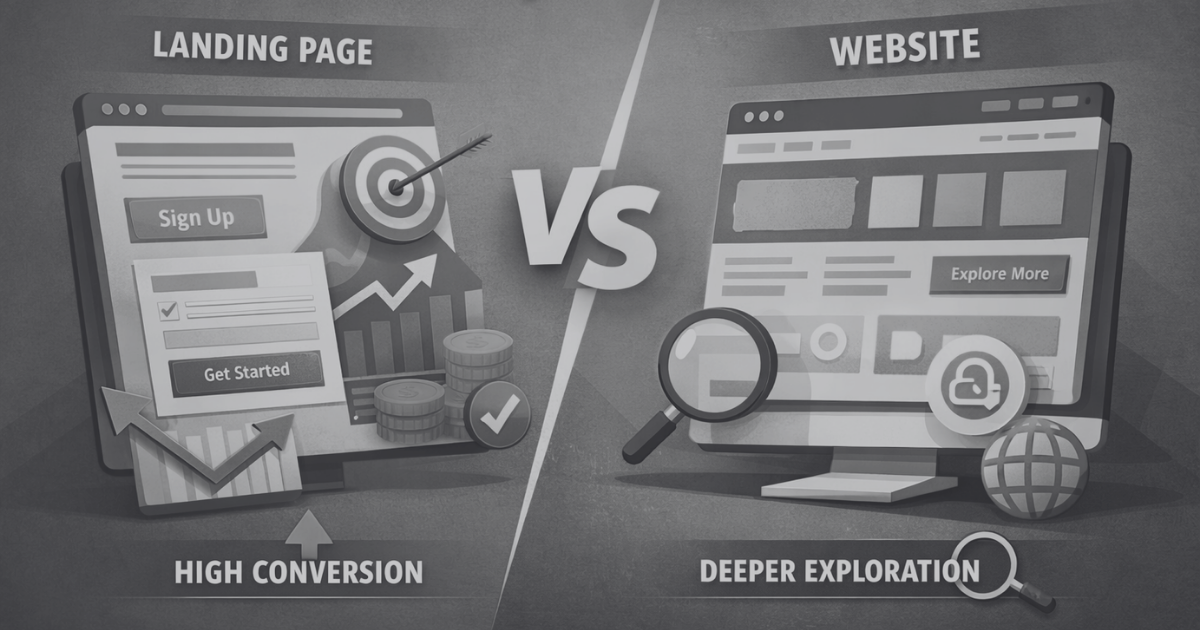
The difference between landing pages and websites comes down to three critical factors: intent, structure, and user behavior.
Landing pages vs websites differ in how they guide user behavior and influence conversion outcomes.
| Category | Website | Landing Page |
| --- | --- | --- |
| Purpose | Exploration and information | Conversion and action |
| Structure | Multi-page, flexible | Single-page, focused |
| User behavior | Browsing and comparing | Evaluating and deciding |
| Best traffic | SEO, organic | Paid, high-intent |
| Conversion rate | Lower | Higher |
### Websites Are for Multi-Path Navigation
Websites are designed for users who may not yet be ready to convert and support:
- Multiple pages and pathways
- Exploration and comparison
- Broad informational needs
- SEO-driven discovery journeys
Visitors can enter at any point and move freely between pages.
### Landing Pages Are for Single Conversion Path
Landing pages are geared toward users who already have intent and arrive via ads, email campaigns, or specific promotions. They feature:
- One clear goal
- No competing navigation
- Focused messaging aligned with a campaign
- Direct call-to-action (CTA) flow
### Intent, Structure, and Behavior
The real distinction is in how users behave. Website visitors browse and compare, while landing page users evaluate and decide.
A good rule of thumb to follow is that when intent is high, structure should be simple. When intent is low, structure should be exploratory.
## When a Website Works Best
A website is the right tool when the user journey requires depth, flexibility, and discovery.
### Organic Traffic or SEO Visitors
When prospects find you through search engines, they are often researching broadly. They may not yet know exactly what they need. A website allows them to explore multiple pages and build trust over time.
### Brand Discovery
For first-time visitors, a website provides credibility. It communicates who you are, what you do, and how you can help solve problems.
### Research-Heavy Decisions
Industries with longer buying cycles, such as architecture, healthcare, or B2B services, require users to compare, validate, and revisit information.
### Multi-Service Companies
If your business offers multiple services or serves different audiences, a website helps organize that complexity in a helpful, easy-to-find way.
## When a Landing Page Works Best
Landing pages excel when the goal is focused conversion tied to a specific action or campaign. The average landing page conversion is [almost 10%](https://marketingltb.com/blog/statistics/landing-page-statistics/) across industries, compared to general webpage conversion rates, which hover around [1% to 4%](https://www.luckyorange.com/blog/posts/good-conversion-rate).
### Paid Advertising (PPC and Social)
Traffic from paid campaigns is expensive and highly targeted. Sending that traffic to a homepage introduces friction and reduces ROI. Instead, landing pages are a direct extension of ad messaging and intent.
For performance-focused campaigns, strategies like [PPC campaigns](https://proiq.com/digital-marketing-solutions/ppc-services) rely heavily on dedicated landing pages to maximize conversion efficiency.
### Campaign-Specific Offers
Whether it’s a seasonal promotion, webinar, or limited-time discount, landing pages keep attention centered on the offer.
### Lead Generation
When the goal is to collect information, such as contact details or qualification data, we’ve seen landing pages consistently outperform multi-page websites.
### Time-Sensitive Promotions
Urgency requires clarity. Landing pages remove distractions and reinforce immediate action.
## Where Most Companies Get It Wrong
Conversion issues rarely stem from traffic volume. Instead, they are often attributed to mismatched page strategies.
### Sending Paid Traffic to a Homepage
This is one of the most common and expensive mistakes. Homepages are not designed for campaign-specific conversion. They are engineered for navigation.
When users land on a homepage after clicking an ad, they are forced to search for relevance. Many simply leave.
### Using Landing Pages for Long-Term SEO
Landing pages are not built for deep site structure or organic discovery. Using them as SEO hubs often limits visibility and creates thin navigation paths.
### Conflicting Messaging Between Ad and Page
If your ad promises one thing and your page delivers another, even subtly, conversion rates drop immediately. Consistency is crucial.
### Too Many Options, Not Enough Direction
When users are presented with multiple CTAs, numerous offers, or competing paths, decision fatigue increases while conversions fall.
## How to Choose the Right Approach
Choosing between a website vs landing page becomes simple when you evaluate four factors:
- **Traffic Source:** Where is the visitor coming from?
- **Intent Level:** Are they exploring or ready to act?
- **Goal:** Is the objective awareness or conversion?
- **Funnel Stage:** Top, middle, or bottom of the funnel?
**Low intent + high exploration = website**
**High intent + specific action = landing page**
This framework removes confusion and ensures page structure matches how users make decisions.
## Why This Decision Directly Impacts ROI
The structure you choose directly influences performance metrics such as:
- Cost per acquisition (CPA)
- Conversion rate
- Lead quality
We’ve seen campaigns with identical traffic perform dramatically differently simply because landing pages replaced general website destinations. When message, intent, and structure are cohesive, conversion rates increase and acquisition costs drop.
Data-driven[marketing](https://blogs.proiq.com/data-driven-marketing-tactics) is essential in these instances. Assumptions about user behavior lead to inefficiencies that only data can reveal.
## The Best Strategy Is Not Either/Or
The most effective digital strategies use webpages and landing pages in tandem.
A website serves as your foundation:
- Builds credibility
- Supports SEO
- Provides information architecture
- Encourages exploration
Landing pages are your conversion layer:
- Capture high-intent traffic
- Support campaigns
- Drive leads and sales
- Remove friction from decision-making
When used together, they create a system where awareness flows seamlessly into action. [Website design and conversion](https://blogs.proiq.com/website-design-that-converts) should work hand in hand, not in isolation.
## Design with the User in Mind
Choosing the wrong page type can actively increase marketing costs and hinder campaign results.
The difference between a website and a landing page comes down to purpose. One is built for exploration, the other for conversion. When you design page structure around user intent, you create a more efficient and profitable marketing system.
If your current funnel is driving traffic but not converting it, the issue may not be your offer but where you’re sending users.

#### Written by [ProIQ](https://blogs.proiq.com/author/proiq)
###### [Previous Post](https://blogs.proiq.com/website-design-that-converts)
[](https://blogs.proiq.com/website-design-that-converts)
###### [Website Design That Converts: What Most Companies Get Wrong](https://blogs.proiq.com/website-design-that-converts)
###### [Next Post](https://blogs.proiq.com/why-website-not-generating-leads)
[](https://blogs.proiq.com/why-website-not-generating-leads)
###### [Why Your Website Isn’t Generating Leads (And How to Fix It)](https://blogs.proiq.com/why-website-not-generating-leads)
- Copyright © 2021 ProIQ |
- [Privacy Policy](https://proiq.com/privacy-policy/)
[](https://www.facebook.com/ProIQAdvisory)[](https://www.linkedin.com/company/proiq-advisory/)[](https://proiq.com/feed/)
```json
{
"@context" : "https://schema.org",
"@type" : "BlogPosting",
"author" : {
"@type" : "Person",
"name" : "ProIQ",
"url" : "https://blogs.proiq.com/author/proiq"
},
"dateModified" : "2026-04-15T14:54:20.048Z",
"datePublished" : "2026-04-15T14:54:20.000Z",
"headline" : "Landing Pages vs Websites: What Drives Higher Conversion?",
"image" : [ "https://blogs.proiq.com/hubfs/landing-pages-vs-websites-conversion.png" ],
"mainEntityOfPage" : {
"@id" : "https://blogs.proiq.com/landing-page-vs-website",
"@type" : "WebPage"
},
"publisher" : {
"@type" : "Organization",
"logo" : {
"@type" : "ImageObject",
"url" : "https://blogs.proiq.com/hubfs/ProIQ%20Logos/ProIQ_Logo-150dpi.png"
},
"name" : "Hire Velocity"
}
}
```