---
title: ProIQ Blog | Explore. Learn. Engage. | Website Design & Development
description: Website Design & Development | Expert insights on digital marketing and recruitment marketing to help organizations attract, engage, and convert the audiences that matter most.
---
- [ info@proiq.com](mailto:info@proiq.com)
- [](https://www.facebook.com/ProIQAdvisory) [](https://www.linkedin.com/company/proiq-advisory/) [](https://proiq.com/feed/)
[ ](https://blogs.proiq.com)
[](https://blogs.proiq.com/tag/website-design-development#tmpmodule_1568761248550301)
- [Home](https://proiq.com/)
- Solutions
- [Recruitment Marketing](https://proiq.com/recruitment-marketing-solutions/)
- [Employer Branding](https://proiq.com/recruitment-marketing-solutions/employer-branding/)
- [Social Media Recruiting](https://proiq.com/recruitment-marketing-solutions/social-media-recruiting/)
- [Geofencing Recruiting](https://proiq.com/recruitment-marketing-solutions/geofencing-recruiting/)
- [Programmatic Job Advertising](https://proiq.com/recruitment-marketing-solutions/programmatic-job-advertising/)
- [Digital Marketing](https://proiq.com/digital-marketing-solutions/)
- [Search Engine Optimization (SEO)](https://proiq.com/digital-marketing-solutions/seo-services/)
- [Pay Per Click (PPC)](https://proiq.com/digital-marketing-solutions/ppc-services/)
- [Content Marketing](https://proiq.com/digital-marketing-solutions/content-marketing/)
- [Social Media Marketing](https://proiq.com/digital-marketing-solutions/social-media-marketing/)
- [Web Design & Development](https://proiq.com/digital-marketing-solutions/web-design-and-development/)
- [Portfolio](https://proiq.com/client-portfolio/)
- [Insights](https://blogs.proiq.com)
- About
- [About ProIQ](https://proiq.com/about-proiq/)
- [ProIQ Team](https://proiq.com/about-proiq/#ProIQTeam)
- [Technology Partnerships](https://proiq.com/about-proiq/#technology-partnerships)
- [Contact](https://proiq.com/contact-us/)
###### 5 min read
## [Website Messaging: How to Make Your Value Clear](https://blogs.proiq.com/how-to-make-your-value-clear-through-website-messaging-proiq)
By [ProIQ](https://blogs.proiq.com/author/proiq) on Sep 9, 2026, 10:58:45 AM
Your website has only [seven seconds](https://www.forbes.com/sites/serenitygibbons/2018/06/19/you-have-7-seconds-to-make-a-first-impression-heres-how-to-succeed/) to let customers know they’ve come to the right place.If visitors can't immediately understand what you do, who you help, and why you're worth considering, they’ll quickly jump to the competition’s page.
The problem isn't always the website but the website messaging.
Good messaging gives your website a clear purpose. It helps prospects understand your value without making them dig through multiple pages, decode industry jargon, or sort through vague claims.
Here's how to make your messaging clearer, more useful, and easier for your audience to act on.
## What Is Website Messaging?
Website messaging is the strategy behind how [high-converting websites](https://blogs.proiq.com/website-conversion-optimization) communicate. It defines the key ideas visitors should understand about your brand, while website copy is the language used to express those ideas through headlines, subheads, service descriptions, and CTAs.
Think of messaging as the cornerstone. Copy is what gets built on top of it. If the foundation isn't clear, even excellent copy can miss the mark.
For example, a company might describe itself as an "innovative provider of comprehensive business solutions." It sounds professional, but it doesn't tell a prospective customer much.
What does the company provide? Who is it for? What problem does it solve? Why should someone choose it?
Strong website messaging answers the questions customers care about most.
## 4 Questions Your Website Must Answer
If your [website has a conversion problem](https://blogs.proiq.com/traffic-vs-conversion), it’s probably not answering these four questions right off the bat:
### What do you do?
Be direct. Avoid clever headlines that sound good but don't explain anything.
**Less helpful:** “Unlocking the future through innovative solutions.”
**More helpful:** “We help manufacturers automate production and improve plant performance.”
Clarity always trumps cleverness. Your headline doesn't need to explain your entire business. It just needs to give visitors enough context to understand what you're offering and decide whether to keep reading.
### Who do you help?
Tell visitors who your business is built for. This could be a particular industry, company size, role, or customer type. When the right prospects immediately recognize themselves in your messaging, they have more reason to explore.
Specificity can also help. Saying you serve “businesses” doesn't tell someone much. Saying you help “multi-location healthcare organizations” or “growing field service companies” creates a much clearer picture. Always cut straight to the chase and avoid ambiguity.
### Why should they choose you?
Generic claims such as “innovative” or “industry-leading” don't tell visitors much.
Instead, identify what genuinely differentiates your business, such as deep expertise or stellar customer service. Then back those claims with proof.
### What should they do next?
Don't make visitors figure out where to go. Use call-to-actions (CTAs) that explicitly describe the next step, such as Explore Our Services, View Customer Results, or Talk With an Expert.
The best CTA depends on the visitor and the page. Someone comparing solutions may need more information, while someone who has already researched your company may be ready to contact your team.
## Craft Your Messaging Around the Customer
Brands often describe what they offer without explaining why it matters. One of our clients listed “24/7 customer support” as a feature on their site. But they neglected to consider what this means for customers.
When reviewing your website, take every major feature and ask: “So what does this help the customer do?”
That question can turn generic service descriptions into much stronger messaging. You can also use this exercise for each major service. List the capability, identify the problem it addresses, and then describe the outcome it helps create.
For example:
- **Capability:** Automated reporting
- **Problem:** Employees spend hours compiling information manually
- **Value:** Teams get the information they need faster and spend less time building reports
That final statement is usually much closer to what customers care about.
## Replace Claims With Proof
Take a look at your website and highlight statements such as:
- We provide exceptional service.
- We're an industry leader.
- Our solutions are cutting-edge.
- Customers trust us.
Then, ask yourself how you can *prove* it.
Replace broad claims with specifics wherever possible. Instead of saying you're experienced, explain the expertise behind that experience. Highlight credentials, awards, and certifications. Rather than saying customers trust you, show testimonials or customer success stories. Instead of promising results, demonstrate them.
Proof can take many forms, including customer testimonials, case studies, years of experience, recognizable clients, measurable results, or examples of the work itself. Always connect the proof to the claim you're making. Don't put testimonials on a page just because you have them. Use them where they reinforce an important message.
## Create a Clear Website Messaging Hierarchy
Your homepage doesn't need to say everything. A simple structure keeps your message focused:
**Value proposition → Supporting message → Differentiators → Proof → CTA**
Start with what you do and who you help. Explain the problem you solve or value you provide. Show what makes you different. Support your claims with evidence. Then give visitors a next step.
This hierarchy helps your team make better decisions about what belongs on the page. If a piece of content doesn't support the primary message, answer an important customer question, or help someone move forward, ask whether it needs to be there.
If everything is presented as equally important, visitors won't know where to focus.
## Keep Messaging Consistent
Your homepage, service pages, about page, and blog should reinforce the same core positioning. That doesn't mean repeating the same language everywhere. Each page should serve a different purpose while supporting the larger story.
For example, if your homepage positions your company as a specialized partner for enterprise organizations, your service pages shouldn't suddenly use vague messaging aimed at “businesses of all sizes.”
Consistency makes your value easier to understand as visitors move through the site.
It's also worth reviewing your messaging periodically. Brands evolve, services change, and audiences shift. Your website should reflect where the business is today.
## Try the Seven-Second Test
Here's a simple way to evaluate your messaging. Show your homepage to someone who doesn't know your company for seven seconds, and then ask them:
- What does the company do?
- Who does it serve?
- What stood out?
- What would you do next?
If the answers are unclear or inconsistent, your messaging may need work.
## Clarity Always Comes First
Strong website messaging says the right things clearly.
Start with your customer's needs. Explain what you do and who you help. Turn features into meaningful benefits. Replace generic claims with proof. Keep your core positioning consistent. Then make the next step obvious.
When visitors can quickly understand your value, your website has a much stronger foundation for everything that follows.
ProIQ combines strategy, messaging, design, and user experience to build websites around your business objectives. [Explore our website design and development solutions](https://proiq.com/digital-marketing-solutions/web-design-and-development/) to learn how we can help optimize website messaging, convert customers, and drive revenue.
###### Topics: [Website Design & Development](https://blogs.proiq.com/topic/website-design-development)
###### 6 min read
## [Your Marketing Doesn't Have a Traffic Problem. It Has a Conversion Problem.](https://blogs.proiq.com/traffic-vs-conversion)
By [ProIQ](https://blogs.proiq.com/author/proiq) on Aug 18, 2026, 9:30:00 AM
More website traffic sounds like a good thing, right? An influx of visitors should drive more opportunities, leads, and customers.
But what happens when traffic spikes, but business results stay the same? While it may seem like the obvious answer, you shouldn’t automatically sink more budget to generate more traffic.
If your existing audience is arriving on your website but failing to take action, sending more people into the same experience won't solve the underlying problem. It simply creates a larger pool of visitors who don't convert.
Conversion optimization deserves a more prominent place in [digital marketing strategy](https://blogs.proiq.com/marketing-strategy-business-outcomes). Brands must create a compelling marketing experience that gives the right people a reason to continue progressing down the funnel.
## More Traffic Doesn't Guarantee Growth
Traffic is easy to measure, which is probably why marketers love talking about it.
You open your HubSpot dashboard and see that website visits are up 25%. It looks good. You can show the graph to leadership and point to the upward trend.
But here's the question that matters more: What did those additional visitors actually do?
Did they fill out a form? Call your sales team? Or make a purchase?
If the answer is no, more traffic may not be improving business results. In fact, [recent analysis of 41,000 landing pages](https://unbounce.com/average-conversion-rates-landing-pages/) found a median conversion rate of just 6.6% across industries, based on 464 million visitors and 57 million conversions.
Imagine your website gets 10,000 visitors every month and 100 of them become leads. Now imagine you increase traffic by 50%. You have 15,000 visitors, but your conversion rate hasn't changed. You might get more leads, but you're also spending more resources to acquire those additional visitors.
Look at the other side of the equation. What happens if you improve your conversion rate from 1% to 2% without increasing traffic?
You just doubled your leads.
Marketing conversion optimization is a powerful growth lever. In our experience, the best opportunity isn't finding more people, but doing a better job with the people you already have.
## Conversion Starts Before the CTA
When people hear the term conversion optimization, they often think about buttons and forms.
Should the CTA button say "Get Started" instead of "Submit"? Should the form have three fields instead of five? Should the button be above the fold?
Those questions are worth asking, but conversion starts much earlier, often with the first impression a visitor gets from your website.
Within seconds, they're trying to figure out whether your company can solve their problems, if they should trust your brand, and what to do next.
If your website doesn't answer those questions immediately, changing the CTA probably won't make much difference.
Strong conversion experiences start with clear, concise, value-first messaging. Your headline should quickly communicate what you do and why it matters. Your copy should focus on the customer's needs instead of listing everything your company offers. Your proof points should make it easier for visitors to believe your claims.
And, most importantly, your offer must make sense for where the visitor is in their journey.
Someone discovering your company for the first time may not be ready to schedule a sales call. They might want to read a case study, download a guide, or learn more about your services first.
An effective conversion strategy gives people relevant ways to move forward based on their needs and intent.
We believe trust matters just as much. Testimonials, case studies, and other social proof let customers know that your company can deliver.
Before you ask someone to convert, give them a reason to believe you can make their lives better.
## Every Marketing Channel Influences Conversion
Conversion hinges on [integrated marketing strategies](https://blogs.proiq.com/integrated-marketing-strategies). Every [digital marketing](https://proiq.com/digital-marketing-solutions/) channel plays a crucial role in influencing what people expect when they arrive on your site.
Take [SEO](https://proiq.com/digital-marketing-solutions/seo-services/). Someone searches for a specific question and clicks on your result. They want the page to answer their inquiry. If they land on a generic service page that doesn't match their search intent, they're likely to leave.
We see brands struggle with the same problems with [PPC](https://proiq.com/digital-marketing-solutions/ppc-services/). If your ad promises one thing but your landing page talks about something entirely different, you've created a disconnect. You paid to get the visitor there, and then the experience gives them a reason to leave.
Content marketing has a similar job. A good blog post shouldn't just attract organic traffic; it should educate readers, demonstrate expertise, build trust, and give them a next step when they're ready to learn more.
Social media creates interest, but that interest needs somewhere useful to go. If someone clicks through from a LinkedIn post and lands on a confusing or irrelevant page, the momentum disappears.
Email marketing gives you an opportunity to tailor the experience even further. Someone who has already downloaded a resource shouldn't receive the same message as someone who has never interacted with your brand.
When all of these channels work cohesively together, they create a stronger customer journey.
## Where Companies Lose Potential Customers
The gap between interest and action can be substantial. Ecommerce offers a clear example: the average online shopping cart abandonment rate is [over 70%](https://baymard.com/blog/ecommerce-checkout-usability-report-and-benchmark), illustrating how quickly potential customers can drop out when friction enters the experience.
This friction is typically caused by small mishaps that add up over time.
Maybe the [website design](https://proiq.com/digital-marketing-solutions/web-design-and-development/) is tough to navigate, the copy is packed with industry jargon, or the CTA is buried halfway down the page.
"Contact Us" isn't a particularly exciting reason to take action. Depending on the audience and buying stage, a free consultation, demo, or educational resource gives visitors a much stronger reason to engage.
Then there are the practical problems.
A form asks for too much information, pages load slowly, and the mobile experience is frustrating. A visitor has to click through four pages to find an answer that should have been obvious on the first one.
These things cause immediate frustration, and that costs conversions.
Website[conversion optimization](https://blogs.proiq.com/website-conversion-optimization) shouldn't be limited to changing button colors or testing headlines. It should look at the entire site experience, from the first interaction with the brand to the moment someone becomes a lead or customer.
## Building a Conversion-Oriented Marketing Strategy
A strong conversion strategy requires building a better system.
First, you must understand who you're trying to reach, what they're looking for, what might stop them from taking action, and what business outcome you're trying to create. You can't optimize an experience if you don't know what you're optimizing it for.
Then look at [content that drives pipeline](https://blogs.proiq.com/content-marketing-for-lead-generation). Is your website answering your target audience's questions? Are you communicating benefits clearly? Are you giving visitors enough information to feel confident moving forward?
Next, consider technology. Analytics, CRM data, heatmaps, A/B testing, and other tools can help identify where people are dropping off and what might be causing it.
But don't let the technology drive the strategy. Data can tell you that visitors are abandoning a page. It takes strategic thinking to understand why.
Finally, make continuous improvement part of the process.
Your website isn't something you build once and forget about. Customer expectations, your business, and competition are always changing. Your own data will continue revealing new opportunities.
Always keep testing, learning, and improving.
## Make Your Marketing Count
There's nothing wrong with wanting more traffic. The problem is assuming traffic is always the answer.
If you're already investing in SEO, PPC, content, social media, and other marketing channels, take a closer look at what happens after people click.
Are visitors finding what they need? Are they taking the next step? And, most importantly, are those interactions contributing to meaningful business outcomes?
At ProIQ, we believe marketing should be connected from the first click to the final outcome. Our [digital marketing solutions](https://proiq.com/digital-marketing-solutions/) bring your channels together to attract the right audience, create stronger conversion experiences, and turn marketing activity into measurable business results.
Ready to get more from the traffic you're already generating? Explore our digital marketing solutions and discover how a more connected strategy can turn interest into action.
###### Topics: [Website Design & Development](https://blogs.proiq.com/topic/website-design-development)
###### 8 min read
## [ADA Website Compliance Isn’t a Plugin (What Organizations Need to Know)](https://blogs.proiq.com/ada-website-compliance)
By [ProIQ](https://blogs.proiq.com/author/proiq) on May 5, 2026, 8:45:00 AM
With the increasing prioritization of accessibility, ADA website compliance has entered a new phase defined by clearer expectations, increased enforcement, and a shrinking margin for error.
While most businesses know accessibility matters, they misunderstand what it entails. They often take action by installing an accessibility widget or overlay, and assume the issue is resolved.
But there’s a significant disconnect in this approach. ADA website compliance is not a tool, but a structural website issue. Accessibility is not something you can apply to a finished website like a filter. It is the result of how a website is planned, designed, built, and maintained over time.
As compliance requirements continue to evolve, especially with updates affecting government entities and educational institutions, brands must rethink their approach to accessibility altogether.
## What Is ADA Website Compliance?
ADA website compliance refers to designing and developing websites that are accessible to users with disabilities, typically by following the [Web Content Accessibility Guidelines (WCAG) and guidance from the](https://www.w3.org/WAI/standards-guidelines/wcag/)[Americans with Disabilities Act (ADA)](https://www.ada.gov/resources/web-guidance/).
At a functional level, accessibility ensures that users can:
- Perceive content, whether through visual, auditory, or assistive means
- Navigate interfaces using keyboards, screen readers, or alternative inputs
- Interact with core functionality such as forms, menus, and buttons
- Understand the structure and meaning of the content presented
This responsibility extends across multiple sectors, including:
- State and local government agencies that serve the public
- Colleges and universities that provide digital access to education
- Public-facing institutions that rely on websites as primary communication channels
- Private-sector organizations that increasingly operate in accessible digital environments
In our experience, accessibility becomes significantly more effective when it’s treated as a usability standard embedded into the experience, not simply a compliance requirement.
## Why ADA Website Compliance Matters More than ever
Accessibility has been part of the digital conversation for years, but its importance has shifted from theoretical to operational. A convergence of factors is accelerating this change and making accessibility a more immediate priority for organizations and brands across sectors.
Several forces are driving this urgency:
- **More Defined Regulations:** [Updates to Title II of the ADA](https://www.ada.gov/resources/2024-03-08-web-rule/) have clarified expectations for public entities, particularly within government and education. While some deadlines have been extended, those extensions are intended to provide time for implementation.
- **Greater Enforcement Activity:** Accessibility-related complaints, audits, and legal actions are becoming more frequent. Organizations are less likely to go unnoticed, and enforcement is less sporadic than it once was. In fact, website accessibility lawsuits increased significantly in recent years. rising by [nearly 42%,](https://www.forbes.com/sites/gusalexiou/2024/01/09/new-york-led-the-way-in-us-web-accessibility-lawsuits-in-2023-report-shows/) reflecting growing enforcement and awareness.
- **Increased Public Awareness:** Users are more informed about accessibility issues and more willing to speak up when they encounter barriers.
The businesses that respond effectively are those recognizing that accessibility requires delivering a functional, modern, and credible website.
## Why Most Websites Are Not ada Compliant
Despite increased awareness, [almost 95% of websites](https://beaccessible.com/post/web-accessibility-statistics/) have at least one detectable accessibility failure, and an average homepage has 51accessibility errors. The reason is often due to a misunderstanding of how accessibility is achieved. Many teams assume that if a website looks modern and functions well visually, it must also be accessible. In reality, accessibility issues often exist beneath the surface.
We consistently see a set of common structural problems:
- Improper or inconsistent HTML structure that disrupts how content is interpreted
- Missing or inadequate alt text that leaves images inaccessible to screen readers
- Navigation systems that cannot be used without a mouse
- Low color contrast that reduces readability for many users
- Poorly structured headings that create confusion for assistive technologies
These issues are often invisible during standard design reviews, but they significantly impact usability for users relying on assistive tools.
The underlying problem is a misalignment in how accessibility is evaluated:
- Organizations may equate visual quality with accessibility
- Development and UX decisions are overlooked in accessibility planning
Many visually polished websites are fundamentally inaccessible because accessibility was never integrated into the build process. These same structural issues can affect performance as well, which is why organizations facing accessibility challenges frequently struggle with engagement and [why your website isn’t generating leads](https://blogs.proiq.com/why-website-not-generating-leads).
## ADA Website Compliance Checklist
For businesses looking to assess their current state, a checklist can help identify common problems. While not exhaustive, these elements provide a good starting point for evaluating accessibility.
Key areas to review include:
- A clear and consistent heading structure (H1 through H6 used logically)
- Descriptive alt text for all meaningful, non-decorative images
- Full keyboard navigation across all interactive components
- Accessible forms with proper labels, instructions, and validation
- Adequate color contrast to ensure readability across devices and conditions
- Compatibility with screen readers and other assistive technologies
This checklist is useful for identifying visible issues, but it does not guarantee compliance. In our experience, accessibility challenges tend to reflect deeper structural problems within the site. Addressing them effectively requires looking beyond individual fixes and evaluating the system as a whole.
## Why “Quick Fix” Accessibility Tools Don’t Ensure ADA Compliance
Accessibility overlays and plugins are often presented as efficient solutions to a complex challenge. They promise rapid implementation, minimal effort, and immediate compliance, making them appealing to organizations seeking a simple path forward.
We understand the appeal. However, in practice, these tools can fall short of delivering full accessibility.
The limitations are significant because these tools cannot:
- Correct flawed or inconsistent HTML structure
- Rebuild navigation systems that are inherently inaccessible
- Ensure proper semantic markup across the site
- Fully align a website with WCAG standards on their own
### Myth vs. Reality
- **Myth:** ADA compliance can be achieved by installing a plugin
- **Reality:** Accessibility requires coordinated design, development, and UX decisions
Overlays can provide incremental improvements, but they cannot replace the foundational work required for complete compliance. When used as a standalone solution, they may create a false sense of completion.
## What Does ADA Website Compliance Actually Require?
Organizations that achieve and maintain compliance approach accessibility as a system. They integrate it into every stage of the website lifecycle, from initial design through ongoing maintenance.
We see four critical components in effective accessibility strategies:
- **Accessibility-First Design:** Design decisions around color, typography, spacing, and interaction patterns directly impact usability. Accessibility must be considered from the outset.
- **Semantic, Standards-Based Development:** Clean, structured code is essential. Proper use of HTML elements, ARIA attributes, and logical hierarchy ensures that assistive technologies can interpret and present content accurately.
- **Inclusive User Experience (UX):** Navigation, workflows, and interactions must be intuitive and usable for a diverse range of users.
- **Continuous Improvement:** Websites are dynamic. Accessibility must be monitored, tested, and maintained over time.
ADA website compliance depends on how your site is structured, built, and maintained over time, requiring a strategic approach to [website design and development](https://proiq.com/digital-marketing-solutions/web-design-and-development/).
## How Do You Know If Your Website Is ADA Compliant?
One of the most common challenges we see is uncertainty. Many companies believe that they are compliant but lack the data to support that assumption. Without visibility, it’s difficult to make informed decisions or prioritize improvements.
Several indicators suggest a website may not be compliant:
- The site was built without accessibility considerations in place
- No formal accessibility audit has been conducted
- Compliance efforts rely primarily on third-party tools
- The website has not been updated or modernized in several years
If any of these conditions apply, the next step should be a structured accessibility audit.
An audit provides a clear understanding of current issues, prioritizes remediation efforts, and establishes a roadmap for compliance. Without this step, organizations are operating without a reliable baseline.
## How ADA Website Compliance Improves Performance and UX
The impact of accessibility extends way beyond compliance. Businesses that invest in accessibility frequently see measurable improvements across their digital performance.
Accessibility can contribute to:
- More intuitive and frictionless UX
- Higher engagement across a broader audience
- Improved conversion rates and clearer user pathways
- Expanded reach to users who might otherwise be excluded
- Increased trust and credibility with both users and stakeholders
When a website becomes easier to use for people with disabilities, it becomes easier to use for everyone.
## What Should Public Organizations Do About ADA Website Compliance?
For public-facing organizations, particularly in government and education, accessibility is an essential responsibility. Delaying action increases both risk and complexity, especially as expectations continue to evolve.
Incremental fixes are rarely sufficient. A more effective path forward includes:
- Conducting a comprehensive accessibility audit to establish a baseline
- Developing a structured, phased remediation plan aligned with priorities
- Evaluating whether the current website can support compliance or requires a rebuild
In many cases, achieving compliance requires rethinking how the website is built from the ground up, starting with a structured [web design and development strategy](https://proiq.com/digital-marketing-solutions/web-design-and-development/). Taking a proactive approach allows organizations to manage this process strategically rather than reactively.
## Key Takeaway: ADA Website Compliance Is a Long-Term Strategy
ADA website compliance is not a one-time fix or a tool you install. It is a long-term strategy that depends on how your website is designed, developed, and maintained.
## ADA Website Compliance FAQs
### **What is ADA website compliance?**
ADA website compliance refers to designing and developing websites that are accessible to users with disabilities, typically by aligning with WCAG standards and ensuring compatibility with assistive technologies. In practice, it reflects how a website is structured, built, and experienced—not just how it looks.
### **Do I need an ADA compliant website?**
For organizations that serve the public—particularly in government, education, and other public-facing sectors—accessibility is increasingly expected and, in many cases, required. Even outside of those sectors, accessibility is becoming a standard component of modern, usable websites.
### **Can a plugin make my website ADA compliant?**
Accessibility tools and overlays can support certain aspects of usability, but they cannot resolve the underlying structural and code-level issues that determine full compliance. Without addressing those foundational elements, compliance remains incomplete.
### **How do you know if your website is ADA compliant?**
Most organizations cannot determine this with certainty without a structured evaluation. An accessibility audit provides visibility into compliance gaps, identifies risks, and outlines what needs to be addressed to meet accessibility standards.
### **What happens if a website is not ADA compliant?**
In addition to potential legal and regulatory exposure, non-compliant websites often create usability barriers that limit engagement, reduce reach, and negatively impact overall performance. Accessibility issues rarely exist in isolation—they tend to reflect broader structural challenges within the site.
## Get Your Website ADA-Compliant Ready
ADA website compliance has evolved into a defining component of modern web strategy. Organizations that rely on quick fixes or surface-level solutions will continue to encounter challenges, risks, and missed opportunities. Those that take a structural approach and integrate accessibility into design, development, and ongoing maintenance are better positioned for long-term success.
Accessibility is about building websites that function effectively for all users, and that foundation shapes everything that follows.
###### Topics: [Website Design & Development](https://blogs.proiq.com/topic/website-design-development)
###### 6 min read
## [Website Conversion Optimization: What Actually Moves the Needle](https://blogs.proiq.com/website-conversion-optimization)
By [ProIQ](https://blogs.proiq.com/author/proiq) on Apr 29, 2026, 9:29:59 AM
Website conversion rate optimization (CRO) has been diluted into a checklist of tactics, such as testing a headline, adjusting a button, or shortening a form. While these actions are not inherently wrong, they can reflect a limited view of what drives performance.
The most successful brands approach website conversion optimization differently. They treat it as a discipline rooted in decision-making, one that determines how users interpret value, navigate complexity, and build trust.
The shift is subtle but significant. CRO is not about what you change, but rather how effectively your site enables action.
## Key Takeaways
- CRO is not about testing tactics. It is about improving how users make decisions.
- The largest performance gains come from fixing structure, messaging, and user flow.
- Data reveals where users drop off, but strategy determines what to change.
- Simplicity and clarity consistently outperform complexity.
- Strong CRO increases the ROI of every marketing channel.
## What Is Conversion Rate Optimization?
Conversion rate optimization is the systematic improvement of how a website turns attention into action. It focuses on increasing the percentage of users who take a defined next step while improving the quality and intent behind those actions.
This distinction is important.
Design determines presentation. Marketing drives visibility. CRO governs decision-making. It addresses the moment where a visitor evaluates relevance, weighs risk, and chooses whether to proceed.
Most websites underperform because they fail at this moment of decision, which is often why businesses struggle with [why their website isn’t generating leads](https://blogs.proiq.com/why-website-not-generating-leads).
CRO and [website design that converts](https://blogs.proiq.com/website-design-that-converts) exist to resolve that failure, driving profits. Brands that invest in CRO report an [average ROI of 223%](https://sqmagazine.co.uk/conversion-rate-optimization-statistics/).
## Why Most CRO Efforts Fail
### Random A/B Testing Without Strategy
Testing has become synonymous with optimization, but testing without a point of view is directionless. We see brands that run experiments in isolation, without understanding user behavior, produce fragmented insights and negligible impact.
Effective CRO begins with a thesis: a clear perspective on what is limiting performance and why.
### Focusing on Small Tweaks Instead of Core Issues
Incrementalism is often mistaken for progress. Adjusting surface elements may produce marginal lifts, but it doesn’t address the structural reasons users do not convert.
The most meaningful gains come from confronting foundational questions: Is the value clear? Is the path intuitive? Is the decision easy?
### Ignoring User Intent and Behavior
Websites are sometimes built on what the business wants to say rather than what the user needs to understand, creating conflict. CRO fails when it does not account for the context in which users arrive and the outcomes they are seeking.
### Lack of Data and Measurement
Data is an effective diagnostic tool. Without it, brands may default to opinion.
Yet data alone is insufficient. We always recommend clients connect behavioral patterns to strategic decisions.
## The Core Areas That Impact Conversion Rates
While tactics vary, high-performing websites consistently excel in a few key areas.
### Messaging and Value Proposition
Clarity of value is the starting point of conversion. Users do not invest time in understanding ambiguity.
Effective messaging reduces cognitive effort. It articulates relevance quickly and positions your services or products within the user’s priorities.
### Page Structure and User Flow
Structure determines whether users move forward or disengage.
A strong user flow anticipates questions, sequences information logically, and removes unnecessary decisions. It guides the user toward making a decision.
### Call-to-Action Strategy
A call-to-action (CTA) must resolve uncertainty and reinforce value.
When CTAs are vague, excessive, or poorly placed, they signal hesitation. When they are precise and contextual, they accelerate decisions.
### Trust Signals and Credibility
Trust is a variable in every conversion. Without it, even the best offers fail.
Credibility is built through evidence, demonstrating outcomes, recognizable affiliations, and consistent messaging. It reduces perceived risk and supports confident decisions.
## How to Approach CRO Strategically
A strategic approach to website conversion optimization requires discipline and prioritization.
### Start With Data
Behavioral data reveals where performance breaks down. It highlights not just what users do, but where intent weakens. This is the starting point for meaningful improvement.
### Identify Friction Points
Friction is rarely dramatic. It is often subtle, showing up in an unclear phrase, an unnecessary step, a missing reassurance.
Yet these moments accumulate. Identifying and addressing them creates disproportionate gains.
### Prioritize High-Impact Changes
The difference between activity and impact lies in prioritization based on [data-driven marketing](https://blogs.proiq.com/data-driven-marketing-tactics). High-performing teams focus on user behavior, as revealed by data, to optimize conversion.
## What Moves the Needle
The most effective CRO strategies are defined by laser precision. They focus on a small number of high-leverage improvements.
### Simplifying User Journeys
Complexity introduces hesitation. Simplification, including fewer steps and clearer paths, can boost completion rates.
### Aligning Messaging With Intent
We’ve seen conversion rates improve when messaging reflects the prospect’s goals. This requires alignment between acquisition channels and on-site experience. When expectations are met, users move forward with ease.
### Improving Page Clarity
Clarity is undervalued because it appears obvious. In practice, it’s rare. High-performing pages eliminate ambiguity. They make the value, the process, and the next step immediately clear.
### Reducing Friction
Friction is the cumulative effect of small inefficiencies. Removing it requires close attention to detail.
| Area | What Improves | Business Impact |
| --- | --- | --- |
| Messaging | Clear value proposition | Higher engagement and trust |
| Structure | Logical user flow | Increased conversions |
| CTAs | Clarity and placement | More completed actions |
| Trust Signals | Credibility and proof | Reduced hesitation |
| Friction | Simplicity and speed | Higher completion rates |
## CRO and Marketing Performance
Conversion rate optimization should be treated as a function across all marketing efforts.
### Impact on PPC ROI
Paid acquisition creates opportunity. Conversion determines return. Improving conversion rates increases output without increasing spend, enhancing the efficiency of [PPC campaigns](https://proiq.com/digital-marketing-solutions/ppc-services/).
### Impact on Lead Quality
CRO influences not just how many users convert, but *which* ones convert. Clear positioning and structured experiences attract higher-intent prospects, improving downstream outcomes.
### Impact on Overall Marketing Efficiency
When conversion improves, every channel becomes more effective. Traffic carries greater value, and marketing investments produce stronger ROI.
## Website Conversion Rate Optimization Is an Ongoing Process
Optimization is a continuous process of refinement. As user expectations evolve, so must the experience. Sustained performance requires ongoing analysis, iteration, and adjustment.
Our clients who view CRO as a capability consistently outperform competitors.
## Boost Your CRO
Website conversion optimization requires a clear understanding of how users think, how they make decisions, and how experiences influence action. The goal is to remove friction, clarify value, and guide users forward. When approached at this level, CRO can strengthen all other marketing efforts.
Explore our [web design and development services](https://proiq.com/digital-marketing-solutions/web-design-and-development/) to build a site designed for sustainable success.
Explore our [web design and development services](https://proiq.com/digital-marketing-solutions/web-design-and-development/) to build a site designed for measurable, sustainable growth
###### Topics: [Website Design & Development](https://blogs.proiq.com/topic/website-design-development)
###### 7 min read
## [Why Your Website Isn’t Generating Leads (And How to Fix It)](https://blogs.proiq.com/why-website-not-generating-leads)
By [ProIQ](https://blogs.proiq.com/author/proiq) on Apr 22, 2026, 9:30:00 AM
Are your lead gen rates falling flat despite active ad campaigns and strong SEO rankings?
If so, low conversion could be the culprit.
People are finding your website, but the experience isn’t convincing them to take the next step. Your messaging might be unclear, or the value may not be obvious. Small gaps like these reduce lead volume, even when other marketing strategies are working well.
One of a website’s main purposes is to turn interest into action. When it doesn’t clearly communicate value and guide users forward, opportunities are lost immediately.
If you’re wondering why your website is not generating leads, the answer begins with understanding why existing visitors aren’t converting once they arrive.
Most websites don’t fail because of traffic. They fail because they are not built to convert.
## Key Takeaways
- More traffic does not guarantee more leads; conversion systems determine performance.
- Unclear messaging, weak calls-to-action, and poor structure are the most common conversion barriers.
- Design alone rarely improves results without a clear conversion strategy behind it.
- Aligning page content with visitor intent increases trust and conversion rates.
- Continuous testing and optimization turn websites into scalable lead-generation systems.
## The Real Problem Is Traffic Without Conversion
One of the most common growth mistakes we see businesses make is treating traffic as the final goal.
Traffic is only useful when visitors take meaningful action, such as filling out a form, downloading a resource, or contacting sales. Without that next step, website visits become a vanity metric rather than a business result.
Think of it this way: driving traffic to an underperforming website is like pouring water into a leaking bucket. More volume does not solve a broken system.
This is why conversion strategy matters. A business may double its lead volume faster by improving its website conversion rate than by doubling traffic spend.
If you are focused solely on attracting more visitors, it may be time to evaluate whether your site is built to convert. Strong [website design that converts](https://blogs.proiq.com/website-design-that-converts) starts with understanding user behavior, not just visual presentation.
## 4 Reasons Websites Fail to Generate Leads
Many lead-generation issues can be traced back to four repeatable patterns.
| Issue | Impact on Conversion | Fix |
| --- | --- | --- |
| Unclear value proposition | Users leave quickly | Clarify messaging |
| Weak CTAs | No action taken | Add clear next steps |
| Poor structure | Users get lost | Simplify flow |
| Intent mismatch | Low relevance | Align page to traffic |
### 1. Unclear Value Proposition
When a visitor lands on your site, they should understand the who, what, where, and why of your business in seconds.
If your homepage relies on vague slogans, generic language, or internal jargon, users will leave confused. Prospects should not have to figure out your business. If they need to interpret your message, you have already introduced friction.
A strong value proposition is specific, relevant, and customer-centered. It speaks to outcomes rather than offerings.
### 2. Weak or Missing Calls-to-Action
Many websites unintentionally force visitors to guess the next step because of:
- No visible contact button
- Generic “Learn More” links everywhere
- Buried forms
- CTAs that appear only once at the bottom of a page
- No urgency or benefit attached to the action
Every page should clearly tell visitors what to do next. That next step must be obvious, accessible, and compelling.
### 3. Poor Page Structure and User Flow
Even the best content can fail when presented poorly.
If pages are cluttered, overly long, difficult to scan, or visually disorganized, users lose focus. When navigation is confusing or too many options compete for attention, decision-making slows down.
Effective page structure guides attention in a logical sequence:
1. Problem
2. Solution
3. Proof
4. Next step
Visitors should never feel lost. They should naturally move through the page toward conversion.
### 4. Messaging That Doesn’t Match Audience Intent
One of the biggest issues we see in lead generation is intent mismatch.
Different traffic sources arrive with different goals. Your website must meet visitors where they are. High-converting websites align message, offer, and page experience with the user’s reason for visiting.
## Why Design Alone Won’t Fix the Problem
When leads slow down, many companies decide they need a redesign. Sometimes they do, but not for the reason they think.
Aesthetic updates can improve credibility and modernize perception, but beautiful design does not automatically boost conversions.
The most effective websites combine:
- Clear positioning
- Strong messaging
- Intentional user flow
- Conversion-focused CTAs
- Trust-building proof points
- Clean, usable design
Without those fundamentals, a redesign becomes cosmetic rather than commercial.
## How to Fix a Website That Isn’t Converting
Improving lead generation requires a practical framework rooted in user behavior and business goals.
### Clarify Your Core Message
Start by simplifying what you say. Ask yourself:
- Can a new visitor understand our offer in five seconds?
- Do we lead with customer outcomes or company features?
- Are we using language our audience actually uses?
- Is our differentiation obvious?
Your homepage headline, supporting copy, and service pages should clearly communicate value. Replace vague statements with direct language tied to how you solve problems and make customers’ lives better.
### Simplify the User Journey
Every extra step creates drop-offs. Audit your website experience and remove friction by:
- Reducing unnecessary navigation choices
- Shortening forms
- Improving mobile usability
- Making buttons easy to find
- Keeping page layouts scannable
- Using a clear messaging hierarchy
The easier it is to act, the more people will act.
### Align Pages With Traffic Sources
Not all traffic should land on the same page. A visitor from Google Ads searching for a service should arrive on a page specifically about that service. A returning prospect may need a faster path to contact.
This is what makes landing page strategy essential. Matching traffic source to page intent improves relevance, trust, and conversion rates. Well-built [PPC campaigns](https://proiq.com/digital-marketing-solutions/ppc-services/) perform better when paired with dedicated landing pages rather than when all clicks are sent to a homepage.
Brands with 40+ landing pages convert [12 times as many leads](https://www.hubspot.com/marketing-statistics) as those with just a couple.
### Strengthen Calls-to-Action
Calls-to-action should be visible, repeated appropriately, and benefit-oriented.
Instead of passive CTAs, use language tied to outcomes:
- Request a Free Consultation
- Get a Custom Quote
- Book Your Strategy Call
- See Pricing Options
- Speak With an Expert
Also consider placement:
- Above the fold
- Mid-page after key benefits
- Bottom of page after proof points
- Sticky mobile buttons where appropriate
The goal is to make the next step easy and obvious. Also, be sure to personalize your CTAs to the customers you’re targeting, as these convert [202% better](https://www.hubspot.com/marketing-statistics).
## The Role of Data in Improving Lead Generation
The highest-performing websites leverage data to improve continuously. Key metrics we recommend every business track include:
- Conversion rate
- Form completion rate
- Bounce rate
- Time on page
- Scroll depth
- Click behavior
- Traffic source performance
- Cost per lead
These KPIs reveal where users engage, where they hesitate, and where opportunities are being lost.
Based on your findings, consider A/B testing. Small improvements in headlines, page layouts, CTA copy, offer positioning, or form length can create significant gains over time.
Modern lead generation depends on [data-driven marketing](https://blogs.proiq.com/data-driven-marketing-tactics) principles: observe behavior, test changes, measure outcomes, repeat.
## Make Your Website a Lead-Gen Machine
If your website is not generating leads, the issue might be conversion performance. Visitors arrive, but the site does not clearly communicate value, guide action, or align with intent.
That is good news because conversion problems are solvable.
When you combine strategic messaging, streamlined user journeys, stronger call-to-action, and continuous optimization, your website becomes an active contributor to revenue growth.
###### Topics: [Website Design & Development](https://blogs.proiq.com/topic/website-design-development)
###### 9 min read
## [Landing Pages vs Websites: What Actually Drives Conversion](https://blogs.proiq.com/landing-page-vs-website)
By [ProIQ](https://blogs.proiq.com/author/proiq) on Apr 15, 2026, 10:54:20 AM
A common issue we see in digital marketing is simple but expensive: companies send traffic to the wrong type of page. These mistakes lead to lower conversion rates, higher acquisition costs, and underperforming campaigns.
While many teams debate landing pages vs websites, a better approach is understanding when to use each and how that decision directly impacts conversion performance.
In this guide, ProIQ’s marketing specialists will break down the difference between landing pages and websites and explain how each plays a distinct role in an effective digital ecosystem.
Most conversion problems don’t come from traffic quality. They come from sending the right audience to the wrong page type.
## Key Takeaways
- Websites are built for exploration, navigation, and brand discovery.
- Landing pages are intended to turn visitors into leads or customers.
- Sending high-intent traffic to the wrong page structure significantly reduces conversion rates.
- Campaign performance is directly tied to message alignment between the ad and the destination page.
- The highest ROI comes from using both websites and landing pages strategically together.
## What Is a Website?
A website is a multi-page digital presence designed to represent a company as a whole. It provides structure, depth, and navigation for users who want to explore, compare, and understand your business.
The primary purposes of a website are:
- Brand storytelling and credibility
- Catalog of services, industries, or resources
- SEO visibility across a broad range of keywords
- Informational discovery rather than immediate action
In most cases, a website serves as the central hub of your brand’s digital identity. Users arrive through search engines, referrals, or direct traffic and move through different pages as they gather information.
However, because websites are built for flexibility and exploration, they can present obstacles when the goal is fast conversion.
For companies focused on improving performance, structure matters. That’s why we often emphasize principles that support [website design that converts](https://blogs.proiq.com/website-design-that-converts) because not all website traffic behaves the same way, and design must reflect intent.
## What Is a Landing Page?
A landing page is a standalone page designed with the single, focused objective of converting leads.
Unlike a website, a landing page removes distractions, including unnecessary navigation, competing messages, and secondary goals. Everything on the page is intentionally built to guide the user toward a single action, such as:
- Filling out a lead form
- Booking a consultation
- Signing up for a service
- Downloading a resource
- Completing a purchase
Landing pages are built for decision-making moments, not exploration. They align tightly with a specific campaign, audience segment, or offer.
We’ve seen landing pages outperform general website pages simply because they eliminate choice overload. When users are given one clear path, they are much more likely to follow it.
## Landing Pages vs Websites: Key Differences
The difference between landing pages and websites comes down to three critical factors: intent, structure, and user behavior.
Landing pages vs websites differ in how they guide user behavior and influence conversion outcomes.
| Category | Website | Landing Page |
| --- | --- | --- |
| Purpose | Exploration and information | Conversion and action |
| Structure | Multi-page, flexible | Single-page, focused |
| User behavior | Browsing and comparing | Evaluating and deciding |
| Best traffic | SEO, organic | Paid, high-intent |
| Conversion rate | Lower | Higher |
### Websites Are for Multi-Path Navigation
Websites are designed for users who may not yet be ready to convert and support:
- Multiple pages and pathways
- Exploration and comparison
- Broad informational needs
- SEO-driven discovery journeys
Visitors can enter at any point and move freely between pages.
### Landing Pages Are for Single Conversion Path
Landing pages are geared toward users who already have intent and arrive via ads, email campaigns, or specific promotions. They feature:
- One clear goal
- No competing navigation
- Focused messaging aligned with a campaign
- Direct call-to-action (CTA) flow
### Intent, Structure, and Behavior
The real distinction is in how users behave. Website visitors browse and compare, while landing page users evaluate and decide.
A good rule of thumb to follow is that when intent is high, structure should be simple. When intent is low, structure should be exploratory.
## When a Website Works Best
A website is the right tool when the user journey requires depth, flexibility, and discovery.
### Organic Traffic or SEO Visitors
When prospects find you through search engines, they are often researching broadly. They may not yet know exactly what they need. A website allows them to explore multiple pages and build trust over time.
### Brand Discovery
For first-time visitors, a website provides credibility. It communicates who you are, what you do, and how you can help solve problems.
### Research-Heavy Decisions
Industries with longer buying cycles, such as architecture, healthcare, or B2B services, require users to compare, validate, and revisit information.
### Multi-Service Companies
If your business offers multiple services or serves different audiences, a website helps organize that complexity in a helpful, easy-to-find way.
## When a Landing Page Works Best
Landing pages excel when the goal is focused conversion tied to a specific action or campaign. The average landing page conversion is [almost 10%](https://marketingltb.com/blog/statistics/landing-page-statistics/) across industries, compared to general webpage conversion rates, which hover around [1% to 4%](https://www.luckyorange.com/blog/posts/good-conversion-rate).
### Paid Advertising (PPC and Social)
Traffic from paid campaigns is expensive and highly targeted. Sending that traffic to a homepage introduces friction and reduces ROI. Instead, landing pages are a direct extension of ad messaging and intent.
For performance-focused campaigns, strategies like [PPC campaigns](https://proiq.com/digital-marketing-solutions/ppc-services) rely heavily on dedicated landing pages to maximize conversion efficiency.
### Campaign-Specific Offers
Whether it’s a seasonal promotion, webinar, or limited-time discount, landing pages keep attention centered on the offer.
### Lead Generation
When the goal is to collect information, such as contact details or qualification data, we’ve seen landing pages consistently outperform multi-page websites.
### Time-Sensitive Promotions
Urgency requires clarity. Landing pages remove distractions and reinforce immediate action.
## Where Most Companies Get It Wrong
Conversion issues rarely stem from traffic volume. Instead, they are often attributed to mismatched page strategies.
### Sending Paid Traffic to a Homepage
This is one of the most common and expensive mistakes. Homepages are not designed for campaign-specific conversion. They are engineered for navigation.
When users land on a homepage after clicking an ad, they are forced to search for relevance. Many simply leave.
### Using Landing Pages for Long-Term SEO
Landing pages are not built for deep site structure or organic discovery. Using them as SEO hubs often limits visibility and creates thin navigation paths.
### Conflicting Messaging Between Ad and Page
If your ad promises one thing and your page delivers another, even subtly, conversion rates drop immediately. Consistency is crucial.
### Too Many Options, Not Enough Direction
When users are presented with multiple CTAs, numerous offers, or competing paths, decision fatigue increases while conversions fall.
## How to Choose the Right Approach
Choosing between a website vs landing page becomes simple when you evaluate four factors:
- **Traffic Source:** Where is the visitor coming from?
- **Intent Level:** Are they exploring or ready to act?
- **Goal:** Is the objective awareness or conversion?
- **Funnel Stage:** Top, middle, or bottom of the funnel?
**Low intent + high exploration = website**
**High intent + specific action = landing page**
This framework removes confusion and ensures page structure matches how users make decisions.
## Why This Decision Directly Impacts ROI
The structure you choose directly influences performance metrics such as:
- Cost per acquisition (CPA)
- Conversion rate
- Lead quality
We’ve seen campaigns with identical traffic perform dramatically differently simply because landing pages replaced general website destinations. When message, intent, and structure are cohesive, conversion rates increase and acquisition costs drop.
Data-driven[marketing](https://blogs.proiq.com/data-driven-marketing-tactics) is essential in these instances. Assumptions about user behavior lead to inefficiencies that only data can reveal.
## The Best Strategy Is Not Either/Or
The most effective digital strategies use webpages and landing pages in tandem.
A website serves as your foundation:
- Builds credibility
- Supports SEO
- Provides information architecture
- Encourages exploration
Landing pages are your conversion layer:
- Capture high-intent traffic
- Support campaigns
- Drive leads and sales
- Remove friction from decision-making
When used together, they create a system where awareness flows seamlessly into action. [Website design and conversion](https://blogs.proiq.com/website-design-that-converts) should work hand in hand, not in isolation.
## Design with the User in Mind
Choosing the wrong page type can actively increase marketing costs and hinder campaign results.
The difference between a website and a landing page comes down to purpose. One is built for exploration, the other for conversion. When you design page structure around user intent, you create a more efficient and profitable marketing system.
If your current funnel is driving traffic but not converting it, the issue may not be your offer but where you’re sending users.
###### Topics: [Website Design & Development](https://blogs.proiq.com/topic/website-design-development)
###### 7 min read
## [Website Design That Converts: What Most Companies Get Wrong](https://blogs.proiq.com/website-design-that-converts)
By [ProIQ](https://blogs.proiq.com/author/proiq) on Apr 8, 2026, 9:15:00 AM
Many companies are not underperforming because they lack traffic. They underperform because their website fails to convert the traffic they already have. Across industries, typical conversion rates range from a measly [2% to 5%](https://www.demandsage.com/cro-statistic), with 5% considered strong.
Traffic versus conversion is a crucial distinction that is often overlooked. Brands invest in SEO, paid media, and content, expecting growth to follow. When results fall short, the instinct is to increase spend or try a new channel. In reality, the issue is often much closer to home.
In our experience, conversion-focused website design is one of the most under-optimized assets in the marketing stack. Websites are treated as a branding exercise rather than a revenue-driving system. Design decisions are made based on preference, not performance. Messaging is written to sound good rather than to convert.
A website should not exist merely to represent your business. It should exist to provide value to users and move them toward a decision. If it fails to do that, every marketing effort connected to it becomes less efficient.
## Key Takeaways
- Most websites fail because they are built for aesthetics instead of conversion.
- Increasing traffic will not fix a low-performing website.
- Clarity and structure drive results more than design trends.
- Conversion improves when messaging aligns with user intent and traffic sources.
- Ongoing optimization is required to sustain performance gains.
## What Is Conversion-Focused Website Design?
Conversion-focused website design is a discipline. It is the intentional structuring of a website to drive specific business outcomes and should answer three questions immediately:
- What does this company do?
- Is it relevant to me?
- What should I do next?
If a website cannot answer those questions within seconds, it is already underperforming.
There is a clear difference between visual design and performance-driven design. Visual design shapes perception, while performance-driven design influences behavior. One captures attention; the other converts it.
This distinction becomes especially important when traffic increases. Companies that invest in [SEO basics](https://blogs.proiq.com/seo-basics-improve-rankings) often see gains in visibility, but without a conversion-focused foundation, that visibility does not translate into pipeline or revenue.
## Why Most Business Websites Underperform
Website underperformance is predictable. It follows the same patterns across industries, regardless of company size or marketing budget. We see these issues consistently.
Website performance rarely fails because of tools or traffic. It fails because the system is not designed to convert.
### Designed for Looks, Not Outcomes
Many websites are built to satisfy internal stakeholders instead of external users. The focus is on brand expression, visual polish, and subjective preferences.
This approach ignores how users actually behave. Visitors are scanning for relevance. If they cannot quickly understand the value, they leave.
A visually impressive site that lacks clarity will underperform a simpler site that communicates effectively.
### No Clear User Journey
A website without a defined user journey forces visitors to navigate on their own. This is where many conversions can be lost.
High-performing websites are structured with intent. They guide users from initial awareness to action through a deliberate sequence. Each section builds on the previous one, reducing friction and reinforcing value.
Without that structure, engagement becomes inconsistent and unpredictable.
### Weak Messaging and Positioning
Messaging is the primary driver of conversion, yet it is often the least developed component of a website.
Generic headlines, vague claims, and jargon create confusion. Users should not have to interpret what a company does or why it matters. Messaging should be clear, valuable, and personalized. In fact, brands that take a personalized approach see a [200% increase in ROI](https://www.paypal.com/us/brc/article/personalized-marketing-and-customer-conversion).
Our clients who have improved messaging alone saw significantly increased conversion rates, often without any design changes.
### No Alignment with Traffic Sources
Traffic carries context. A user clicking a paid ad, a search result, or a social post arrives with specific expectations.
When the landing page does not match those expectations, trust breaks down. This is one of the most common reasons paid campaigns fail to scale.
## The Core Elements of a High-Converting Website
High-performing websites are built around conversion-focused design principles that prioritize clarity, structure, and alignment.
### Clear Value Proposition Above the Fold
The first section of a website determines whether a user stays or leaves. There is no margin for ambiguity.
A strong value proposition communicates what the business does, who it serves, and why it matters, immediately and without any confusion.
Anything less introduces doubt, and doubt reduces conversion.
### Conversion-Focused Page Structure
Structure is what turns information into action.
A high-performing page follows a logical progression: it establishes value, builds credibility, addresses objections, and then presents a clear next step.
Calls to action are not effective in isolation. They are effective when they are supported by context and positioned at the right moment.
### Alignment Between Traffic and Landing Pages
Every marketing channel sets a promise. The landing page must fulfill it.
Businesses running [PPC campaigns](https://proiq.com/digital-marketing-solutions/ppc-services/) frequently make the mistake of sending traffic to generalized pages. This creates a disconnect that lowers conversion rates and increases acquisition costs.
When landing pages support other marketing channels, and all messaging is cohesive, users move forward with confidence.
### SEO and Content Integration
A website should be designed to support growth over time. That requires integrating SEO and content into its foundation.
This includes clear page hierarchy, strategic internal linking, and content that aligns with search intent. When these elements are built into the structure, the site becomes a scalable acquisition channel.
Without this integration, growth remains dependent on paid efforts.
### Data, Testing, and Continuous Optimization
No high-performing website remains static. Performance is the result of continuous refinement.
We’ve seen that brands committed to [data-driven marketing](https://blogs.proiq.com/data-driven-marketing-tactics) consistently outperform those that don’t. They measure user behavior, test variations, and iterate based on outcomes.
Without this process, performance plateaus and opportunities are missed.
## Website Design vs Website Performance
There is a fundamental misunderstanding in how businesses evaluate websites. They prioritize design when they should be prioritizing performance.
A website should be judged by how effectively it converts users into leads, customers, or applicants.
Strong design supports performance, but it does not replace it. When forced to choose, performance should always take precedence.
| Focus | Traditional Website Design | Conversion-Focused Design |
| --- | --- | --- |
| Goal | Visual appeal | Business outcomes |
| Decision driver | Preference | Data and behavior |
| Structure | Flexible | Intentional |
| Messaging | Brand-focused | User-focused |
| Success metric | Aesthetics | Conversion rate |
## How Website Design Impacts Marketing Results
Website design is not a standalone function. It directly influences the effectiveness of every marketing channel.
### Impact on PPC Performance
Paid media amplifies the strengths and weaknesses of a website.
If the landing experience is unclear or misaligned, conversion rates decline, and costs increase. In many cases, improving the website produces a greater return than increasing ad spend.
### Impact on SEO
Search performance is increasingly tied to user engagement. If visitors do not quickly find what they need, they leave, and rankings suffer.
A well-structured, conversion-focused website improves both engagement and visibility, creating a compounding effect.
### Impact on Content Effectiveness
Content generates interest, but the website converts it.
Without clear pathways to action, content becomes an awareness tool rather than an asset that converts leads. A strong website ensures that content contributes to measurable outcomes.
### Impact on Conversion Rates Overall
Every marketing effort leads back to the website. If conversion rates are low, the entire system becomes inefficient.
Improving website performance increases the value of every visitor, making growth more predictable and sustainable.
## How to Evaluate If Your Website Is Limiting Performance
Most websites show clear signs when they are underperforming. The issue is acknowledging it. Some red flags to look out for include:
- Messaging is unclear or overly broad
- Conversion rates are consistently low
- Key pages have high bounce rates
- Calls to action are weak or poorly placed
- There is no structured approach to testing and optimization
If these issues are present, the website is not supporting growth.
## Optimize Website Design Conversion
A website is a performance asset.
When it is built correctly, it bolsters marketing efforts, improves efficiency, and drives measurable results. When it is not, it can undermine every channel connected to it.
The solution is not more traffic, more campaigns, or more content. It is a better system.
If your website is not converting, it is time to address the foundation. Explore our [web design and development services](https://proiq.com/digital-marketing-solutions/web-design-and-development) to build a site that performs as amazing as it looks.
###### Topics: [Website Design & Development](https://blogs.proiq.com/topic/website-design-development)
###### 1 min read
## [Goldleaf Farms Unveils New Website Design with Store + Video Marketing](https://blogs.proiq.com/goldleaf-farms-unveils-new-website-design-with-online-store-video-marketing)
By [Sara West](https://blogs.proiq.com/author/sara-west) on Aug 25, 2021, 12:46:15 AM
**Client:** Goldleaf Farms
**Scope:** Branding, Content Marketing, Website Design & Development, Social Media Marketing, Search Engine Optimization (SEO)
Visit [www.goldleaffarms.com](http://www.goldleaffarms.com)
### Project Description:
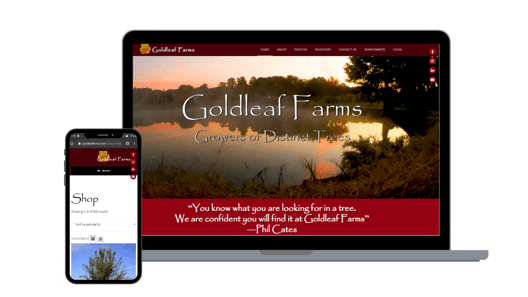
Goldleaf Farms is an ornamental tree farm based outside of Atlanta with nearly 300 acres between 2 farms in Georgia and Mississippi. As ‘Growers of Distinct Trees’, Goldleaf Farms was looking to modernize its brand with a new mobile-enabled website and online store, social media presence, and overall digital identity. ProIQ worked with Goldleaf Farms to bring the owner, Phil Cates’, vision to life with a unique website design and presence.
## New Website Design with Online Store
The ProIQ team partnered with Phil to highlight drone footage of the Georgia farm throughout the website as well as the 150+ varieties of trees on the new mobile-enabled online store. By using the category and tag functionality to group the unique characteristics of each tree species, customers can identify the optimal tree based on height, spread, shape, foliage, fall color, farm location, genus, species and cultivar.
## DIgital Identity Redesign + Video Marketing
Working with Phil, ProIQ developed a strategy to refresh the company’s identity across the social media platforms and on Google to drive greater brand awareness and organic traffic to the website.

###### Topics: [Customer Stories](https://blogs.proiq.com/topic/customer-stories) [Digital Marketing](https://blogs.proiq.com/topic/digital-marketing) [Website Design & Development](https://blogs.proiq.com/topic/website-design-development) [Social Media Recruiting](https://blogs.proiq.com/topic/social-media-recruiting)
[All posts](https://blogs.proiq.com/all)
- Copyright © 2021 ProIQ |
- [Privacy Policy](https://proiq.com/privacy-policy/)
[](https://www.facebook.com/ProIQAdvisory)[](https://www.linkedin.com/company/proiq-advisory/)[](https://proiq.com/feed/)
```json
{
"@context" : "https://schema.org",
"@type" : "VideoObject",
"contentUrl" : "https://5370676.fs1.hubspotusercontent-na1.net/hubfs/5370676/ProIQ%20-%20Blog%20Media/Phils%20Final%207.mp4",
"dateModified" : "2023-10-20T23:24:33.817Z",
"description" : "",
"duration" : "PT34.068S",
"height" : 2160,
"name" : "Phils Final 7",
"thumbnailUrl" : "https://blogs.hirevelocity.com/hubfs/ProIQ%20-%20Blog%20Media/Phils%20Final%207.mp4/medium.jpg",
"uploadDate" : "2021-06-15T23:34:33.253Z",
"width" : 3840
}
```