


Are your lead gen rates falling flat despite active ad campaigns and strong SEO rankings?
If so, low conversion could be the culprit.
People are finding your website, but the experience isn’t convincing them to take the next step. Your messaging might be unclear, or the value may not be obvious. Small gaps like these reduce lead volume, even when other marketing strategies are working well.
One of a website’s main purposes is to turn interest into action. When it doesn’t clearly communicate value and guide users forward, opportunities are lost immediately.
If you’re wondering why your website is not generating leads, the answer begins with understanding why existing visitors aren’t converting once they arrive.
Most websites don’t fail because of traffic. They fail because they are not built to convert.
Key Takeaways
- More traffic does not guarantee more leads; conversion systems determine performance.
- Unclear messaging, weak calls-to-action, and poor structure are the most common conversion barriers.
- Design alone rarely improves results without a clear conversion strategy behind it.
- Aligning page content with visitor intent increases trust and conversion rates.
- Continuous testing and optimization turn websites into scalable lead-generation systems.
The Real Problem Is Traffic Without Conversion
One of the most common growth mistakes we see businesses make is treating traffic as the final goal.
Traffic is only useful when visitors take meaningful action, such as filling out a form, downloading a resource, or contacting sales. Without that next step, website visits become a vanity metric rather than a business result.
Think of it this way: driving traffic to an underperforming website is like pouring water into a leaking bucket. More volume does not solve a broken system.
This is why conversion strategy matters. A business may double its lead volume faster by improving its website conversion rate than by doubling traffic spend.
If you are focused solely on attracting more visitors, it may be time to evaluate whether your site is built to convert. Strong website design that converts starts with understanding user behavior, not just visual presentation.
4 Reasons Websites Fail to Generate Leads
Many lead-generation issues can be traced back to four repeatable patterns.
| Issue | Impact on Conversion | Fix |
|---|---|---|
| Unclear value proposition | Users leave quickly | Clarify messaging |
| Weak CTAs | No action taken | Add clear next steps |
| Poor structure | Users get lost | Simplify flow |
| Intent mismatch | Low relevance | Align page to traffic |
1. Unclear Value Proposition
When a visitor lands on your site, they should understand the who, what, where, and why of your business in seconds.
If your homepage relies on vague slogans, generic language, or internal jargon, users will leave confused. Prospects should not have to figure out your business. If they need to interpret your message, you have already introduced friction.
A strong value proposition is specific, relevant, and customer-centered. It speaks to outcomes rather than offerings.
2. Weak or Missing Calls-to-Action
Many websites unintentionally force visitors to guess the next step because of:
- No visible contact button
- Generic “Learn More” links everywhere
- Buried forms
- CTAs that appear only once at the bottom of a page
- No urgency or benefit attached to the action
Every page should clearly tell visitors what to do next. That next step must be obvious, accessible, and compelling.
3. Poor Page Structure and User Flow
Even the best content can fail when presented poorly.
If pages are cluttered, overly long, difficult to scan, or visually disorganized, users lose focus. When navigation is confusing or too many options compete for attention, decision-making slows down.
Effective page structure guides attention in a logical sequence:
- Problem
- Solution
- Proof
- Next step
Visitors should never feel lost. They should naturally move through the page toward conversion.
4. Messaging That Doesn’t Match Audience Intent
One of the biggest issues we see in lead generation is intent mismatch.
Different traffic sources arrive with different goals. Your website must meet visitors where they are. High-converting websites align message, offer, and page experience with the user’s reason for visiting.
Why Design Alone Won’t Fix the Problem
When leads slow down, many companies decide they need a redesign. Sometimes they do, but not for the reason they think.
Aesthetic updates can improve credibility and modernize perception, but beautiful design does not automatically boost conversions.
The most effective websites combine:
- Clear positioning
- Strong messaging
- Intentional user flow
- Conversion-focused CTAs
- Trust-building proof points
- Clean, usable design
Without those fundamentals, a redesign becomes cosmetic rather than commercial.
How to Fix a Website That Isn’t Converting
Improving lead generation requires a practical framework rooted in user behavior and business goals.
Clarify Your Core Message
Start by simplifying what you say. Ask yourself:
- Can a new visitor understand our offer in five seconds?
- Do we lead with customer outcomes or company features?
- Are we using language our audience actually uses?
- Is our differentiation obvious?
Your homepage headline, supporting copy, and service pages should clearly communicate value. Replace vague statements with direct language tied to how you solve problems and make customers’ lives better.
Simplify the User Journey
Every extra step creates drop-offs. Audit your website experience and remove friction by:
- Reducing unnecessary navigation choices
- Shortening forms
- Improving mobile usability
- Making buttons easy to find
- Keeping page layouts scannable
- Using a clear messaging hierarchy
The easier it is to act, the more people will act.
Align Pages With Traffic Sources
Not all traffic should land on the same page. A visitor from Google Ads searching for a service should arrive on a page specifically about that service. A returning prospect may need a faster path to contact.
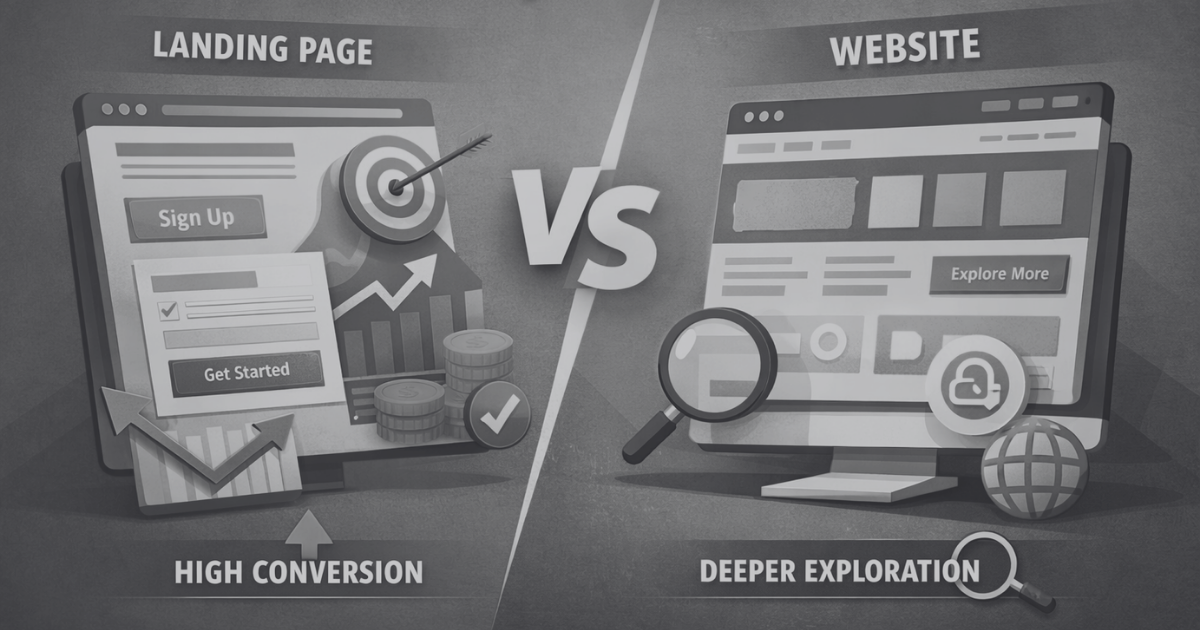
This is what makes landing page strategy essential. Matching traffic source to page intent improves relevance, trust, and conversion rates. Well-built PPC campaigns perform better when paired with dedicated landing pages rather than when all clicks are sent to a homepage.
Brands with 40+ landing pages convert 12 times as many leads as those with just a couple.
Strengthen Calls-to-Action
Calls-to-action should be visible, repeated appropriately, and benefit-oriented.
Instead of passive CTAs, use language tied to outcomes:
- Request a Free Consultation
- Get a Custom Quote
- Book Your Strategy Call
- See Pricing Options
- Speak With an Expert
Also consider placement:
- Above the fold
- Mid-page after key benefits
- Bottom of page after proof points
- Sticky mobile buttons where appropriate
The goal is to make the next step easy and obvious. Also, be sure to personalize your CTAs to the customers you’re targeting, as these convert 202% better.
The Role of Data in Improving Lead Generation
The highest-performing websites leverage data to improve continuously. Key metrics we recommend every business track include:
- Conversion rate
- Form completion rate
- Bounce rate
- Time on page
- Scroll depth
- Click behavior
- Traffic source performance
- Cost per lead
These KPIs reveal where users engage, where they hesitate, and where opportunities are being lost.
Based on your findings, consider A/B testing. Small improvements in headlines, page layouts, CTA copy, offer positioning, or form length can create significant gains over time.
Modern lead generation depends on data-driven marketing principles: observe behavior, test changes, measure outcomes, repeat.
Make Your Website a Lead-Gen Machine
If your website is not generating leads, the issue might be conversion performance. Visitors arrive, but the site does not clearly communicate value, guide action, or align with intent.
That is good news because conversion problems are solvable.
When you combine strategic messaging, streamlined user journeys, stronger call-to-action, and continuous optimization, your website becomes an active contributor to revenue growth.