<img height="1" width="1" style="display:none" src="https://www.facebook.com/tr?id=758779318459048&amp;ev=PageView&amp;noscript=1">
6 min read

The Data Maturity Model for Modern Marketing Teams

By ProIQ on Mar 3, 2026 9:00:02 AM

Marketing teams are flooded by a deluge of data. According to the 2025 Supermetrics Marketing Data Report, marketers are using 230% more data than in 2020, yet 56% say they lack the time to properly analyze and act on it. Volume has increased. Clarity has not. . 

 At ProIQ, we refer to this disconnect as the data abundance problem. Data itself is no longer scarce; clarity is. Reporting has become easier, but intelligence remains elusive. Most teams can generate charts and export metrics. Far fewer can confidently translate those metrics into strategic decisions that influence revenue, hiring, and long-term growth.

That's why a structure data maturity model is essential. Rather than chasing isolated improvements or adopting disconnected tools, a maturity model provides a clear path forward. It defines where you are today, what operational behaviors characterize that level, and what must change to progress.

Without that structure, teams invest in new technologies and data-driven marketing tactics without addressing foundational gaps that limit impact.

What Is a Marketing Data Maturity Model?

A marketing data maturity model is a structured marketing analytics framework that evaluates how effectively a company collects, integrates, analyzes, and activates data to drive better business outcomes. It’s a capability model that defines operational readiness, analytical depth, and decision authority across numerous stages of growth.

The model assesses whether marketing data is used reactively, tactfully, predictively, or strategically. It evaluates alignment between marketing metrics and revenue outcomes, and also examines whether data informs only campaign-level optimization or shapes executive planning and cross-departmental strategy.

In our experience, maturity models are most effective when they are definitive rather than abstract. At ProIQ, we define four progressive levels of marketing data maturity: reactive reporting, structured optimization, predictive intelligence, and revenue intelligence. Each level builds upon the previous one, establishing the operational foundation required to advance. Attempting to skip levels often results in unmet expectations and underutilized investments. 

Level 1: Reactive Reporting

Level 1: Reactive Reporting represents the foundational stage within ProIQ’s marketing data maturity model. At this stage, marketing teams have access to data but lack integration and strategic cohesion. Industry research indicates that over 80% of marketers view data-driven marketing as essential for growth, yet nearly half still struggle to unify data across platforms.

Organizations at this stage often mistake activity for effectiveness. A campaign that generates high traffic might be considered successful, even if conversion quality is poor. Social engagement may be celebrated without examining the downstream pipeline impact. Marketing reports rising performance, but executives still struggle to understand true ROI. 

Disconnected dashboards, manual exports, and inconsistent attribution define this stage. Reporting cycles are reactive, focusing on what happened last month rather than what should happen next month. The result is decision-making based largely on surface-level indicators. 

Level 2: Structured Optimization

Level 2: Structured Optimization represents the second stage within ProIQ’s marketing data maturity model, marked by operational discipline and KPI alignment. At this level, marketing teams establish defined KPIs aligned to funnel stages. Performance reviews occur consistently, and A/B testing frameworks are implemented systematically. Attribution models are maturing, providing campaign-level insights that support more confident decisions.

In our advisory engagements, we often see significant gains at this stage driven purely by improved clarity. When companies define success metrics correctly and tie them to key business outcomes, they unearth more inefficiencies. Improvements in PPC performance, for example, often stem from rigorous testing protocols and tighter KPI governance rather than increased spend — particularly when organizations clarify channel strategy across PPC and SEO

Level 2 should remain retrospective. Teams can explain what worked and what didn’t. They can reduce the cost per acquisition and optimize conversion rates. However, they are still operating within historical data constraints. Forecasting remains limited, and strategic budget allocation is informed by trends rather than predictive modeling.

This is where many organizations can plateau. Optimization improves efficiency, but growth remains incremental rather than transformative. 

Level 3: Predictive Intelligence

 Level 3: Predictive Intelligence represents the third stage within ProIQ’s marketing data maturity model, where marketing transitions from optimizing past performance to modeling future outcomes. 

Predictive intelligence represents a significant increase in capability. Marketing transitions from optimizing past performance to modeling future outcomes. Forecasting becomes integrated into planning, and budget allocation is guided by projected impact rather than historical averages.

Organizations operating at this stage often leverage AI marketing analytics tools to surface patterns that traditional reporting alone would miss. Customer lifetime value modeling, churn prediction, and scenario planning inform decision-making.

Predictive intelligence is also the stage where executive perception of marketing begins to shift. When revenue projections are supported by data modeling and scenario simulations, marketing earns greater strategic credibility.

Similarly, integrating AI SEO tools enables companies to forecast the potential revenue impact of ranking improvements, rather than focusing solely on keyword position changes.

Level 4: Revenue Intelligence

Level 4: Revenue Intelligence represents the most advanced stage within ProIQ's marketing data maturity model. It extends beyond campaign performance to encompass enterprise decision-making. Marketing data integrates with CRM systems, financial forecasting, and operational planning. Attribution is multi-touch and cross-channel. Reporting directly informs executive strategy and capital allocation decisions. 

At this stage, marketing insights influence hiring decisions, territory expansion, and resource allocation. Alignment between revenue projections and recruitment strategy ensures that projected demand is supported by workforce planning. Data becomes a shared organizational asset rather than a departmental tool.

In advanced organizations, marketing intelligence integrates directly with talent advisory initiatives, ensuring workforce strategy aligns with revenue forecasts. Decision automation becomes possible because thresholds and triggers are predefined. Budget reallocations occur systematically when predictive indicators shift.

The defining characteristic of Level 4 is enterprise-wide integration, where marketing intelligence becomes a core driver of organizational strategy rather than a reporting function.

How to Move Up the Data Maturity Ladder

Advancing within ProIQ’s four-stage marketing data maturity model requires deliberate alignment across tools, teams, and governance structures. Businesses often overestimate the impact of technology while underestimating the importance of operational discipline. 

Cohesive tech stacks are foundational. Disconnected systems cap maturity, while a unified marketing analytics portal provides centralized intelligence, enabling consistent attribution and more accurate forecasting. Without integration, predictive modeling remains fragile.

Team capability development is also essential. Advanced analytics tools are ineffective without analytical literacy. Training marketers to interpret models, conduct scenario planning, and communicate insights at the executive level accelerates progression from structured optimization to predictive intelligence.

Governance frameworks ensure that data translates into action. Clear KPI ownership, reporting cadence, and predefined decision thresholds prevent insights from stagnating. We often find that decision automation only works when roles and triggers are explicitly defined.

Lastly, companies must prioritize proper data hygiene. Clean CRM records, consistent campaign naming conventions, and accurate tracking are the foundation of predictive accuracy. In many cases, brands experience measurable performance gains simply by improving data integrity before adopting new systems.

For organizations seeking structured advancement, ProIQ’s digital marketing advisory support provides objective assessment and strategic guidance aligned with your current maturity stage. 

Why Data Maturity Determines Revenue Outcomes

The modern marketing landscape rewards intelligence over volume. As AI-driven search and automation transform customer journeys, brands with low data maturity will struggle to compete with those leveraging predictive and integrated systems.

The level of data maturity an organization achieves determines its decision authority. Higher maturity levels enable confident forecasting, disciplined budget allocation, and cross-functional alignment. Growth becomes more predictable because decisions are grounded in structured intelligence rather than isolated metrics.

If your marketing function feels analytical yet disconnected from measurable revenue impact, it may be time to evaluate your maturity level within ProIQ’s framework. Structured assessment and advisory support can provide the roadmap needed to transform data into revenue intelligence.


Topics: Talent Advisory Digital Marketing
5 min read

2025 Digital Marketing Highlights: ProIQ’s Year in Review

By ProIQ on Dec 23, 2025 8:25:34 AM

As we reflect on 2025, it’s clear the year brought rapid shifts across digital marketing and hiring. AI evolved quickly, consumer expectations changed, and organizations faced new challenges in attracting both customers and talent. Throughout this landscape, our focus remained the same: helping clients stay focused, strategic, and adaptable.

This review highlights the work we accomplished together and the lessons that will shape 2026.

ProIQ’s 2025 Digital Marketing Highlights

Digital marketing in 2025 demanded agility. As algorithms changed and competition intensified, organizations needed strategies grounded in insight rather than assumption. One of our most impactful initiatives this year came from a lead generation strategy designed to help a client expand into a new industry and generate revenue from a previously untouched market.

Performance Highlights

Early in the year, we identified a specific opportunity within the construction industry that aligned with the client’s services and growth goals. Our team conducted detailed research into industry dynamics and buyer behavior, then built a multi-pronged lead generation strategy that included SEO-optimized content, targeted advertising, and industry-focused messaging. This modern digital marketing agency approach was designed to improve relevance and reach.

We launched the campaign in early 2025 and refined it as performance trends emerged. Year-to-date through October, the strategy produced:

2025 Digital Marketing Highlights (1)

  • A 1,553% increase in website visitors
  • More than 60 qualified leads
  • Over 30 opportunities
  • More than 8 new customers

These results reinforced a broader theme from 2025: organizations that stay proactive, data-driven, and open to testing outperform those relying on static strategies.

Strategic Innovations Introduced

This year, we continued evolving our marketing capabilities to meet changing expectations. Key areas of focus included:

  • AI-supported SEO research used to improve keyword targeting, content planning, and search visibility
  • Programmatic advertising for more precise targeting and cost control
  • Industry-specific content strategies aligned to buyer intent
  • Hyper-local campaigns built around regional behavior and demand

These innovations helped clients improve performance and make decisions rooted in real-time insight.

Talent Advisory Successes in 2025

The talent market continued to shift as candidates placed greater emphasis on visibility, transparency, and employer brand credibility. The LinkedIn Global Talent Trends report highlighted many of the same patterns we saw across industries.

How the Talent Market Evolved

Organizations leaned more heavily on recruitment marketing plans as hiring became more competitive. Clearer messaging, stronger employer branding, and more purposeful targeting played a larger role in reaching qualified candidates early. We also saw increased demand for geofencing strategies as local talent markets tightened.

Notable Client Results

One standout recruitment campaign supported a mechanical HVAC company based in the Pacific Northwest. For HVAC sales roles in Oregon and Washington, the strategy generated 91 candidates at a cost per candidate of $15.44 over three months.

This outcome underscored a consistent theme throughout 2025: recruitment success depends on the same strategic foundations that drive marketing outcomes—clear targeting, relevant messaging, and aligned funnels.

Marketing and Hiring Lessons from 2025

A year of fast-moving change produced several insights that will influence how organizations approach growth and talent acquisition. Three lessons stood out.

1. Industry specialization became essential.

Across both marketing and hiring, relevance mattered more than reach. Campaigns tailored to specific industries or functions/departments consistently outperformed broader efforts. When messaging reflected real buyer priorities and industry context, organizations saw stronger engagement and higher-quality leads.

2. Data quality became a strategic advantage.

With ongoing shifts in analytics platforms, attribution models, and privacy regulations, clean and reliable data became a competitive differentiator. Organizations with accurate tracking and stable reporting gained insight, operated with greater confidence, and made better decisions as measurement framework evolved.

At ProIQ, this meant investing in near real-time reporting through our marketing analytics dashboard, giving clients consistent visibility into performance and the confidence to adapt strategies as conditions changed. Those without strong data foundations often struggled to interpret trends or adjust strategies effectively.

3. Candidates behaved like consumers.

Hiring in 2025 increasingly mirrored consumer behavior. Job seekers evaluated employers the way they evaluated brands, prioritizing relevance, transparency, and trust. Recruitment marketing became a critical way to shape those first impressions, and organizations that focused on delivering a strong, consistent candidate experience built stronger pipelines and better long-term outcomes.

These lessons reflect the evolving nature of both marketing and talent acquisition—and the growing importance of alignment between the two.

Behind the Scenes: The People of ProIQ

Our team’s structure shaped our work in 2025, enabling close collaboration and strategies aligned to client goals. This year, we strengthened cross-functional processes, expanded capabilities, and continued building a culture grounded in collaboration, curiosity, and problem-solving. The relationships we build—with each other and with clients—remain central to our success.

What’s Ahead for 2026

As we look ahead, 2026 is shaping up to be less about chasing trends and more about building cohesive, authentic strategies across digital marketing and recruitment marketing. As these disciplines continue to converge, alignment, consistency, and long-term performance will matter more than short-term optimization.

Several priorities are already taking shape.

A Return to Authentic Brand Positioning

In 2026, authenticity will matter more than trying to guess what audiences want to hear. More organizations are reassessing how their brand shows up—moving away from messaging designed to appeal to everyone and returning to a clearer, more honest representation of who they are and who they serve. This shift toward authentic brand positioning will influence marketing strategy, website messaging, and recruitment marketing campaigns alike.

Emerging Recruitment Marketing Formats

Recruitment marketing will continue expanding beyond traditional channels. We expect greater experimentation with new top-of-the-funnel formats, including in-game display and video ads embedded directly within video games. For certain audiences, these environments offer an impactful way to support awareness-driven recruitment marketing and early-stage candidate engagement.

More Integrated Recruitment Marketing Strategies

Recruitment marketing strategies will become more connected across channels. Rather than relying on isolated campaigns, organizations will increasingly adopt integrated approaches that combine targeted advertising, remarketing, and follow-up through SMS and email. These strategies will support more consistent candidate pipelines and stronger recruitment marketing performance.

Greater Emphasis on AEO and GEO

Search behavior continues to evolve, and 2026 will bring a stronger focus on Answer Engine Optimization (AEO) and Generative Engine Optimization (GEO). As AI-driven search experiences become more common, websites will need to be structured differently, prioritizing authority, usefulness and content formats aligned with how answers are generated and surfaced.

AI as an Integrated Marketing Strategy

AI will be treated less as a standalone tool and more as an integrated part of the overall marketing strategy. Rather than segmenting AI into individual tasks or roles, organizations will increasingly apply it across the full lifecycle—from research and planning to execution, analysis, and optimization. When used intentionally, AI will support faster insights and stronger performance without replacing strategic thinking.

As these shifts take shape, our focus remains on helping clients navigate change with collaboration, relevance, and strategies designed to perform over the long term.

Thank You and Looking Forward

To everyone who made 2025 a meaningful year for ProIQ, thank you. The work we accomplished together reflects a shared commitment to thoughtful strategy, clear decision-making, and doing the work the right way.

As you prepare for 2026, whether you are focusing on marketing, hiring, or a more integrated approach, our team is ready to support your goals with solutions built for a fast-changing landscape.

Here’s to the opportunities ahead.

Topics: Talent Advisory Digital Marketing
7 min read

5 Marketing Lessons I Learned Building ProIQ

By Sara West on Nov 20, 2025 9:30:02 AM

When I reflect on the journey of building ProIQ, a lot comes to mind. Late nights, countless cups of coffee, client calls, and the relentless pursuit of better marketing strategies. But if there’s one thing I can confidently say, it’s that I’ve learned more about marketing lessons from real-world experience than from any textbook or course. And that’s what I want to share with you today. 

Hi, I’m Sara, Managing Director of ProIQ. Over the years, we’ve helped brands of all sizes and across numerous industries build campaigns that not only look great but also perform effectively. Along the way, I’ve discovered important insights that have shaped not only how we operate but also how I think about marketing itself. 

Here are the top five marketing lessons I learned building ProIQ.  

Marketing Lesson #1: Listening Comes Before Strategy 

The first, and probably most important, lesson I learned is that listening is more valuable than talking. Too often, marketers jump straight into developing strategies or campaigns without truly understanding their audience. But I’ve seen firsthand that listening first leads to campaigns that actually resonate. 

Listening isn’t just about hearing what clients say. They might tell you what they think they want. It’s about digging deeper and analyzing customer behaviors, studying market trends, and paying attention to the subtle feedback hidden in data. 

For example, one ProIQ client—a national HR consulting firm supporting a large Midwestern healthcare system—initially thought their biggest challenge was attracting more applicants through advertising. But after we audited their candidate journey, employer brand, and application flow, we uncovered something deeper: their main barrier wasn’t awareness at all. It was a confusing application path and a lack of compelling employer messaging. 

By listening first, we recommended an entirely different approach: a custom-branded microsite, an employer brand audit, clearer messaging, and a combined social + search engine strategy. Once implemented, the campaigns began generating high-quality candidates almost immediately across 180+ locations. 

That’s why listening beats assumptions every time. 

So, here’s my first marketing lesson: start every strategy with ears wide open. Whether you’re shaping an employer brand, refining your messaging, or developing content that resonates, listening first ensures your work is stronger, smarter, and more relevant. It’s also the foundation of creating content that truly engages, because the best ideas always come from understanding your audience before you speak to them.  

Marketing Lesson #2: Agility Beats Perfection in Marketing 

Another hard-earned lesson: perfection is often the enemy of progress. Waiting to launch until everything is perfect can mean missed opportunities. Agility is far more valuable. 

I remember partnering with a systems integrator in the Pacific Northwest that wanted to run recruiting ads for commercial HVAC technicians exclusively on LinkedIn. After three weeks of limited performance, we quickly realized the platform wasn’t where their ideal candidates were spending time. Rather than sticking rigidly to the original plan, we pivoted fast and shifted the entire campaign to Meta. 

The outcome?  The Meta campaign generated eight times more qualified candidates within the first 36 hours than LinkedIn had produced in nearly a month. 

I learned that flexibility always wins. Marketing plans need structure, yes, but they also need wiggle room. Markets shift, algorithms evolve, and customer behavior can change overnight—which means your strategy has to be ready to adapt just as quickly. This is a core mindset inside any modern digital marketing agency, where agility consistently outperforms perfection. 

Marketing Lesson #3: People Power Performance 

One of the most underrated aspects of marketing is the human element. I’ve learned that your team and company culture are the workhorse behind every successful campaign. Great marketing isn’t just about clever strategies or sophisticated tools, though I do love HubSpot and Semrush. It’s about collaboration, creativity, and empowerment. 

I prioritize a culture where ideas can flow freely and everyone feels ownership over their work. When team members feel trusted and inspired, they aren’t afraid to take risks, experiment, or innovate. And those experiments often lead to breakthroughs for our clients. 

One of my favorite moments was when a team member proposed rethinking a client’s entire application flow by replacing a standard ATS link with a simplified, custom-built landing page. It seemed like a small change, but our team rallied around it—design, content, development, and strategy all collaborated to bring it to life. 

That single idea dramatically increased conversion rates across multiple clients, from healthcare systems to logistics companies. And it happened because our culture encourages testing, collaboration, and innovation at every level. 

This taught me that people drive performance, not just processes or platforms. Invest in your team, nurture creativity, and watch the results follow. It’s the same people-first mindset that shapes how our own marketing team collaborates every day. 

Marketing Lesson #4: Transparency Drives Growth 

Honesty can sometimes feel risky. However, it’s actually one of the most powerful tools for building trust. I’ve learned that transparency with clients, stakeholders, and even ProIQ’s own team accelerates growth. 

Transparency means reporting honestly, sharing insights, answering questions, and communicating consistently. It also means being upfront about expectations and results. Clients notice, and it builds long-term trust. 

One example that stands out is when we partnered with a national tire and automotive retailer investing heavily in job board advertising. During our initial review, we uncovered major inefficiencies in how their ATS and job boards were integrated. Instead of downplaying the issues, we walked their HR and IT teams through exactly what wasn’t working and why performance was lagging. That honesty led to a collaborative rebuild of their job advertising strategy, improved integrations, and significantly stronger results.  

A key marketing lesson is that honesty is both an ethical and strategic approach. Transparency builds credibility, fosters collaboration, and lays the foundation for sustainable success — something we reinforce through the clarity and insight built into our marketing analytics tools.  

Marketing Lesson #5: What Modern Marketing Really Means 

Finally, building ProIQ taught me that modern marketing is about evolution, not fixed services. Marketing today is dynamic, data-driven, and ever-changing. It’s about creating adaptive, scalable solutions that respond to real-time insights and customer behaviors. 

ProIQ approaches marketing as a continuous cycle of testing, learning, and optimizing. This means moving beyond rigid service packages and focusing on solutions that evolve with the client’s needs. A content strategy we develop today might be supplemented with AI-powered insights tomorrow and personalized campaigns next quarter. Modern marketing requires flexibility, intelligence, and foresight. 

This is my favorite marketing lesson: always think forward. The brands that thrive are those that embrace change, leverage data effectively, and evolve in tandem with their customers.  

Still Learning, Still Growing 

If there’s a final takeaway from building ProIQ, it’s this: marketing is a journey, not a destination. I’ve learned invaluable lessons about listening, agility, people, transparency, and modern strategies. But the learning never stops. Every client, campaign, and challenge brings new insights. 

I’m grateful to our clients, our team, and the countless opportunities that have pushed us to grow, adapt, and rethink marketing every single day. And while we’ve achieved a lot, we’re still building, experimenting, and learning, because that’s what makes marketing exciting. 

Whether you’re a marketer, entrepreneur, or business leader, remember this. The best marketing lessons aren’t found in books. They’re found in experience, reflection, and the willingness to keep pushing forward. 

Topics: Talent Advisory Digital Marketing
8 min read

Meet the Marketing Agency Team Behind ProIQ

By ProIQ on Oct 1, 2025 11:15:00 AM

As a business owner, you have big dreams for your company. ProIQ’s marketing agency team offers the strategies, tools, and guidance to help you achieve them.

Born in Utah, ProIQ is no stranger to mountainous terrain. And just as reaching the summit requires careful planning, perseverance, and a comprehensive trail map, growing your business does too.

That’s why we closely collaborate with you to develop a personalized trail map that unlocks your brand’s full potential. We believe that the best digital marketing strategies don’t come from algorithms alone; they come from people. People who not only understand the landscape of digital marketing and talent advisory, but who are deeply invested in creating innovative, scalable growth solutions tailored to each client’s unique goals.

Think of ProIQ as your tour guides on your journey to the top. We’ll develop a blueprint to help you avoid potential pitfalls, provide the support and guidance to navigate difficult terrain, and ultimately deliver a thorough path that ensures you reach the summit of success.

Keep reading to discover how our tight-knit, senior-level team achieves this, and gain a behind-the-scenes glimpse into the individuals who make the magic happen.

How Our Small Marketing Agency Team Helps You Achieve Big Dreams

In a world full of large agencies with complex hierarchies and endless handoffs, ProIQ takes a different approach. Our team may be small, but we’re mighty and focused.

Direct Access to Experienced Strategists

When climbing a mountain, you wouldn’t want a novice leading you, right? You want an experienced, knowledgeable guide.

When you work with us, you’re not talking to layers of junior staff. You’re working directly with the experts who are building your strategy, managing your campaigns, and writing your code. Every call, every decision, and every deliverable is handled by someone who has done it before and done it well.

Faster Decision-Making and Flexibility

Our lean structure allows us to move quickly. Whether it’s adjusting campaign tactics, responding to emerging trends, or launching something new, we don’t have to navigate internal red tape to get things done.

A Collaborative, Client-Focused Approach

You’re not just another name on a spreadsheet. Every one of our clients gets hands-on attention from our core team of four, not outsourced contractors or bloated account teams. We partner closely with you to understand your business, challenges, and growth opportunities.

The result? Customized strategies, faster results, and a true extension of your internal team.

Meet the ProIQ Team

Each member of our team brings a unique skill set and personality to the table. Get to know more about the people behind your campaigns.

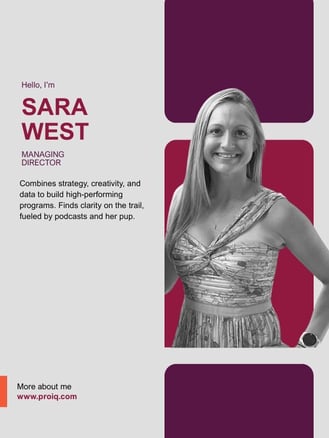
ProIQ_Team_SaraW Sara West

Title: Managing Director

What Sara Does:
Sara blends big-picture strategy with deep data expertise, leading both digital marketing and talent advisory efforts. She excels at the intersection of creativity and analytics, transforming complex campaigns into scalable, high-performing programs that deliver results for clients and their teams.

Expertise Highlight:
“I love data. Nothing brings a smile to my face like an Excel spreadsheet. I’ve been told I have a unique ability to use both the left and right sides of my brain, perfect for performance marketing, which combines creativity with vast amounts of data.”

Fun Fact:
Sara is a die-hard Penn State football fan and outdoor enthusiast. When she’s not leading strategy sessions, you’ll find her hiking, mountain biking, or overlanding with her three dogs, or skiing once the snow hits.

Productivity Tip:
Sara’s productivity hack? A daily trail run with her Chief Happiness & Security Officer (a very good dog). “I carve out 30 to 45 minutes every afternoon to clear my head and think through big-picture strategy while listening to my favorite economics podcasts. It resets my brain for the rest of the day.”

Creative Spark:
Sara’s office is filled with green plants, candles, and dog toys. Small details that create a calm, inspiring environment for focused thinking.

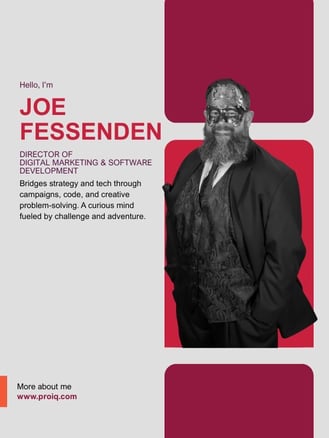
ProIQ_Team_JoeFJoe Fessenden

Title: Director of Digital Marketing & Software Development

What Joe Does:
Joe is your go-to for all things technical and strategic. As the daily point of contact for client campaigns and custom web/software development, he bridges the gap between marketing strategy and technical execution.

Expertise Highlight:
"I often write code for fun. Some people do sudoku and crosswords. I write computer code 🤓." 

Fun Fact:
Joe is an avid traveler who thrives on the road less traveled. He once crossed Siberia by train and is planning a trip to Nepal to see red pandas in their natural habitat. His love of adventure fuels his curiosity and creativity at work.

Productivity Tip:
“When writing code, it's sometimes a good idea to just delete and start over. Like in creative writing, the first attempt helps us get our mind around the problem. Then we can more clearly write the next round.”

Creative Spark:
Joe’s creativity kicks in when faced with a challenge. “An interesting problem gets me going more than anything. I enjoy finding a creative solution to issues.”

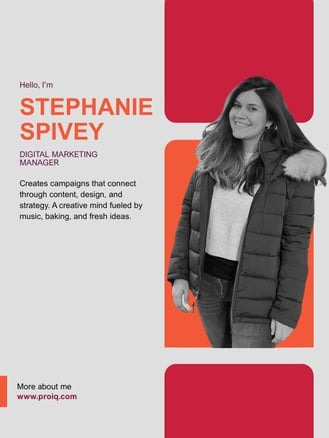
ProIQ_Team_StephanieSStephanie Spivey

Title: Digital Marketing Manager

What Stephanie Does:
Stephanie develops compelling, results-driven campaigns through content that connects. From social media posts to SEO-friendly blogs and digital ad copy, she ensures every message supports both marketing goals and sales initiatives with style and strategy.

Expertise Highlight:
Stephanie is a Canva wizard. “Design is where strategy meets creativity. I love creating visuals that not only look great but also drive engagement and tell a story.”

Fun Fact:
When she’s not building out brand assets, you’ll probably find her in the kitchen. “Baking is one of my favorite creative outlets. It’s a lot like marketing. Mix the right ingredients, follow the process, and add a little flair.”

Productivity Tip:
A carefully curated playlist fuels her focus. “Music keeps me in the zone. Whether it’s lively pop or Latin beats, I use sound to stay energized throughout the day.”

Creative Spark:
Stephanie’s most inspired ideas come during quiet moments. “Sometimes, the best way to think creatively is to step away from the noise. That space gives me clarity and a fresh perspective.”

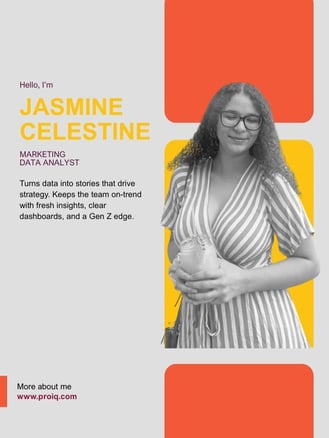
ProIQ_Team_JasmineCJasmine Celestine

Title: Marketing Data Analyst 

What Jasmine Does:
Jasmine is the data engine behind the marketing machine. She builds dashboards, monitors KPIs, and provides crystal-clear insights that help the team make smarter, faster decisions and deliver informed recommendations to clients.

Expertise Highlight:
Jasmine is a pro at turning raw numbers into compelling stories. “I love taking massive data sets and shaping them into something that actually drives strategy.”

Fun Fact:
She’s the team's unofficial Gen Z translator, always on top of the latest trends and social media shifts, especially TikTok. Though we're still trying to figure out if she’s on TikTok or just knows way too much about it.

Productivity Tip:
Clear dashboards fuel Jasmine’s focus. “I work best when data is clean, structured, and visual. It keeps my thinking sharp and helps me turn numbers into strategies that actually drive results.”

Creative Spark:
Whether it’s through data or horses (yes, she rides!), Jasmine finds inspiration in motion. Her creativity shows up in the way she brings numbers to life with visuals that not only tell a story but also give clients a clearer path forward.

How Our Team Works with Clients

Our client-centric process is built on strategy, communication, and integration. Here’s how our methodology sets us apart and helps you reach your goals faster:

Strategy-First Approach

We don’t jump into tactics blindly. Every project kicks off with a deep dive into your goals, audience, and competitive landscape. That way, everything we build, from search engine optimization (SEO) to paid ads to content marketing, is designed to move the needle.

Digital Marketing Meets Talent Advisory

One of the things that makes us unique is our dual expertise in digital marketing and talent advisory. We don’t just help you grow your brand; we also help you grow your team. Whether you're looking to attract new leads or new talent, we bring a 360° perspective to your business.

Transparent Communication and Reporting

You’ll always know what we’re working on, how your campaigns are performing, and what’s coming next. Our clients appreciate our straightforward, no-fluff communication style and consistent reporting cadence. ProIQ is your go-to modern digital marketing agency for real results.

ADAPTING TO CLIENT NEEDS

Just as the digital landscape evolves, so do our clients’ needs. Our team thrives on adapting quickly, whether it is scaling campaigns, shifting strategies, or bringing in specialized skills. This flexibility ensures we can meet clients where they are today while preparing them for tomorrow.

Our Team Culture and Values

The real secret behind our results? Culture.

We’ve intentionally built a company culture that values innovation, transparency, and teamwork, not just internally, but also in how we engage with our clients.

Do the Right Thing

Honesty and integrity are at the core of everything we do. We believe in honest conversations, clear expectations, and delivering what we promise, every time.

Adapt and Grow

We’re always looking for smarter ways to solve problems. A continuous pursuit of self-development and improvement is in our DNA.

Strength in Diversity

Every member of our team brings something extraordinary to the table. We believe our uniqueness maximizes our impact.

And yes, we’re also dog lovers! One of Sara’s dogs, Piper, is Chief Happinees and Security Officer and is a familiar face around the ProIQ office.

The Faces Behind Your Success

At the end of the day, we know you have options when it comes to choosing a marketing partner. But here’s the truth:

Working with ProIQ doesn’t feel like outsourcing. It feels like expanding your internal team with a crew of seasoned pros who care as much about your growth as you do.

Our clients trust us because we show up. We listen. We strategize. We execute. And we do it all with creativity, integrity, and a passion for what we do.

While we are the faces of ProIQ, we are supported by a talented team of designers, developers, writers, and editors who help us deliver the creative and technical excellence our clients count on.

So, if you're looking for a team that’s small in size but big in results, you’ve found it. Let’s summit the marketing mountain together. Ready to get started? Contact us today.

Topics: Talent Advisory Digital Marketing
8 min read

Effective Sourcing Talent Tips to Find Top Candidates

By ProIQ on Aug 13, 2024 10:00:00 AM

Finding the right talent is often challenging, and as many as 75% of companies struggle to recruit effectively.

Whatever industry you're in, sourcing talent when you need it is vital. Every business relies on the skills and dedication of its employees, so you want to make sure you have a team that's going to help guide your company toward success.

There are all kinds of candidate-sourcing methods that different businesses have implemented over the years, and some are more effective than others. You want to have an understanding of the ones that work best and how you can implement them.

In this guide, we'll go over some of the most effective talent acquisition strategies that you could use for your business. Let's get started.


Create an Ideal Candidate Persona

Before you even start looking for new talent, you should determine what you're after. An ideal candidate persona is perfect for this.

Create a profile that details the specific skills, qualifications, and characteristics that you need. This will help you find the most relevant candidates.

When you create any job listings, you can base them around this persona. When candidates are looking at the listing, they'll have a much clearer idea of whether or not they fit the role.


Revisit Former Candidates

The average corporate role receives about 250 applications, and you could easily get more than this. You'll only interview a handful of these; then just one will get the job. This means that there were 249 people who felt like they fit the role but weren't successful.

When another position comes up, one of these 249 applicants could be perfect for it. It can be a good idea to review these candidates and engage with the ones who seem to fit the ideal candidate persona you created.

You should already have their data, which most businesses save in a recruitment management system (RMS), applicant tracking system (ATS), or another database. This can help you go through these candidates effectively.

In some cases, you won't even need to advertise the position at all. You may be able to find the perfect person out of your previous candidates, helping streamline the recruitment process.


Create and Maintain a Sourcing Pipeline

With a suitable RMS, you can use data from previous candidates to create and maintain a sourcing pipeline. You can build the foundation from this data, and you could also consider adding passive candidates to the pipeline. These are candidates who aren't currently seeking new opportunities but may be in the future.

If you prefer, however, you could create a separate pipeline for passive candidates. This may help keep things more organized as these ones won't have been through the same vetting process yet.

You can categorize candidates within this pipeline based on skills, qualifications, and experience. This will help you better match them to future job openings.

Analyze the qualifications and skills of past candidates and compare them to the future hiring needs of your organization. Look for any skill gaps so you can determine which areas may need a stronger talent pool.

Keep your active and passive candidates separate within the RMS data. Having separate segments will make sure your outreach and engagement go to the right candidates.

Use your sourcing pipeline to regularly communicate with candidates. You can implement a nurturing strategy including elements like company updates and relevant job alerts to keep them in the loop.


Build a Strong Employer Brand

Employer branding can be one of the most important aspects of finding suitable talent. This is because a bad reputation will make people far less likely to want to work for your company. As many as 86% of job seekers will look at ratings and reviews when they're looking for a new company to work for.

Building a strong employer brand will help attract a lot more talent, making it easier to find the perfect candidate for a specific role. This will also speed up and streamline the recruitment process.

Making sure different teams collaborate can help with this. Your marketing team should work with anyone involved in the recruitment process to develop a strong employer branding strategy. If you already have one, they should be constantly working to improve it where possible.


Create Personalized Outreach

When communicating with anyone, you're likely to get a better response when things are more personal. This remains true when recruiting.

Any time you reach out to potential candidates, a personal touch can help increase the chances of a positive response. The data you have on these candidates can help with this.

There are various approaches you can take towards this, but it can be a good idea to keep things concise. Try to keep emails to around 200 words or less. If you start writing too much, people will be less likely to read everything.

You shouldn't just personalize the email, but the subject line too. This will make it far more likely that candidates will actually open any emails you send them.

Make sure you keep the tone of any emails friendly and respectful. If you don't hear anything back, don't be afraid to follow up after a few days. When they do respond, make sure you reply promptly to maintain engagement.


Go Virtual

One of the most effective recruitment tips that you should follow in today's world is to take advantage of the latest technology. There are always new ways to connect with potential candidates, and organizations that use the best tools available to them will generally get the best results.

For example, recruiters are now making use of virtual reality (VR) to give job seekers a highly immersive experience. Your company can take part in virtual job fairs which will give you a chance to connect with candidates with ease. You can engage with people from anywhere while still providing a personal touch.

You can also use VR to help show your company's work environment. Candidates will be able to get a clearer idea of the work culture they can expect as well as the job role they'll be filling. Not only can this approach help you find the best talent, but it can also save time and resources.


Optimize Your Careers Page

This can be easily overlooked, but it's a simple way to improve your chances of finding the best candidates. Many recruitment best practices are in terms of how you present your business, as this can hugely impact how many job seekers you attract. When looking at a career page, job seekers are likely to leave if they're not impressed with what they see.

This is a part of your branding strategy, and your careers page can act as a type of passive sourcing channel. If anyone is searching for work in your industry, you want your careers page to show up. Effective search engine optimization will help your page rank higher in search engine results, which will directly impact how many people end up on your site.

Make sure this page (along with the rest of your site) is user-friendly and easy to navigate. The layout and information should all be clear, and it's a good idea to categorize jobs based on departments, locations, or other important aspects.

Include a search function that allows users to look for specific roles. This will help speed things up and improve the user experience.


Encourage Employee Referrals

When looking for new hires, you can encourage your current employees to make recommendations. In many cases, this can be a very effective approach.

Your employees already have first-hand experience with your company, so they have a good understanding of your work environment, business values, mission, and more. As such, they're only likely to recommend candidates that they know will be a good fit.

Many companies use employee referral programs to help spur this on. A simple example would be to offer a cash reward to employees who refer candidates that the company ultimately hires. Clearly communicate any programs to managers and employees so they understand exactly how they work.

It's important to still take referred candidates through the same screening and evaluation processes as any other applicants. This will help you ensure you don't take on anyone who isn't well-suited for the job.


Don't Overlook Internal Candidates

Sometimes, finding the right talent doesn't involve hiring techniques. You may already have the best candidates right under your nose.

Depending on the role you're trying to fill, you might have someone perfect for the job already working at your company. Allowing internal mobility means you can fill positions quickly with individuals who you're familiar with. As you know, they already fit in well at your company; all you need to do is determine if they have the right skills and experience for a specific job role.

Your employees will value this too. Internal mobility gives them the chance to expand their horizons and follow new career paths. Development is incredibly important to employees, so they'll appreciate the opportunity to grow their skills and gain new experience.

Educate your managers about internal mobility and how it works. When it comes time to find someone for a certain position, you can then speak to your managers about their current team members. They'll likely be able to suggest suitable candidates to you, helping streamline the process.


Keep Informed of the Company's Growth Plans

While you may be recruiting for roles you need to fill now, you should always be thinking about the future. You want to take on employees that will be good for your company in the long run. To do this, you need to understand where your company is heading.

Make sure you know what your company's growth plans are. This will give you a clearer idea of which teams need to grow, and you can then determine the kind of employees you need to take on.

You should maintain communication with leadership so you're always on the same page as them in terms of the direction of the company. Take part in important meetings so that you're aware of important updates and changes.

Collaborate with managers and department heads so you can work with them to identify specific expansion requirements. They know their teams, so they can inform you of what they need.

With these insights, you'll be able to better anticipate future talent needs. You can then create a talent acquisition roadmap with clear details about the positions that you need to fill and when.


Measure Your Recruiting Metrics

Data is crucial to success in today's world, and it comes from all kinds of places. You can collect data when recruiting that you can later use to improve your strategies.

Keeping track of metrics and analyzing them can give you in-depth insights that you can use to make better-informed decisions. Some of the metrics you may want to track for recruitment include:

  • Cost per hire
  • Time to fill
  • Applicant quality
  • Source of hire

These will show you how effective your talent acquisition process is. You can then decide how to make improvements moving forward.

Think about your organization's sourcing goals to determine the most suitable metrics to track. Set up systems to collect this data efficiently. An RMS, along with HR analytics software, can be ideal here.

Pay attention to trends over time. You can regularly update and review data so that you know what adjustments will be most helpful.


The Best Approach to Sourcing Talent

Sourcing talent can prove very difficult, and while the above strategies can be helpful, sometimes the best option is to seek help from professionals. A talent advisory company can help you find the best talent for any position your business needs to fill. ProIQ works to help businesses strengthen their operations through high-quality recruitment strategies.

We can help with social media recruiting, geofencing recruiting, programmatic advertising, and more. We're partnered with some of the best software providers, such as HubSpot, WP Engine, and Microsoft Advertising, allowing us to deliver industry-leading services. Get in touch with our team today to schedule a consultation.

Topics: Talent Advisory Recruitment Marketing Geofencing
2 min read

Ultimate Guide to Recruitment Marketing

By Sara West on Oct 27, 2021 10:00:00 AM

HOW TO WIN THE RACE FOR TALENT AT EVERY STAGE OF THE JOB SEARCH

Recruiting in a job seeker’s market gets complicated quickly. In addition to stiff competition for quality candidates, employers must consider cultural fit, engagement strategies, and talent attraction strategies that reach beyond the job board. If recruiters don’t zero in on hiring the right person the first time, recruiting costs will skyrocket as retention drops and turnover escalates.

In December of 2019, the Bureau of Labor Statistics reported 6.4 million job openings. That’s down over 10% from the same time last year, but it still outpaces the 5.9 million hires that took place during that month. These numbers often play out in favor of candidates, especially those with high-demand skills. Candidates can afford to be choosy about the positions they accept, and employees don’t have to stick around in a job that isn’t a good fit. With online reviews and social media at their fingertips, they can make decisions based not only on the specifics of the role, but also on what it’s like to actually work for a specific company.

Employers, meanwhile, must compete with hundreds of other companies for qualified talent. People with the right skills might be few and far between. The best candidates will likely receive offers from multiple employers, especially in high demand fields like technology or healthcare. To compete, employers must be more strategic about the ways they find and attract talent.

The stakes are high, and the right hire could make the difference between success and failure in the marketplace. So how can you boost your chances of securing the talent you need?

It starts with recruitment marketing.

Table of Contents: Recruitment Marketing

  • What is Recruitment Marketing?
    • The Funnel: How Marketing Intersects with Talent Attraction
    • Why Job Postings Aren't Enough
  • The Starting Gate: Position Yourself for Success with Candidates
    • Candidate Personas: Get to Know Your Ideal Candidate
    • SEO / SEM: Find Your Candidates Online
  • Run the Race: Plan & Execute Your Strategy
    • Awareness
    • Consideration
    • Interest
  • Clock Your Time: Recruitment Marketing Metrics & KPI's
Topics: Talent Advisory Recruitment Marketing
2 min read

ProIQ Combines Digital Marketing and Talent Advisory Solutions to Help Companies Attract Talent

By Sara West on Oct 6, 2021 7:30:00 AM

Based in Salt Lake City, Utah, ProIQ serves clients across the country in their efforts to market smarter, Hire Smarter, and grow stronger.

Every company faces unique challenges and ProIQ believes that they should be met with innovative solutions. Their approach combines a passion for data with a love of digital marketing to develop solutions that drive results for talent acquisition, sales, and marketing teams. As a new division of Hire Velocity - an industry leader in Recruitment Process Outsourcing based in Atlanta, Georgia - ProIQ serves as a full-service digital marketing agency with a focus on attracting candidates using digital recruiting strategies.

Managing Director, Sara West, will be leading ProIQ in focusing on Digital Advisory and Talent Advisory solutions. Previous to her new role, West was the Director of Strategic Development at Hire Velocity where she helped shape brand strategy to build market awareness, develop inbound and outbound lead strategies to acquire new customers. Before joining Hire Velocity, Sara served as an Investment Banking Financial Analyst for Signal Hill Capital Group (now DCS Advisory) in New York, where she specialized in the IT services and IT security software sectors. There, she played a pivotal role in researching, evaluating, and executing major deals, completing extensive due diligence for both buy-side and sell-side transactions.

“I’m excited to help companies implement innovative digital strategies, like social media and programmatic job advertising, to better position themselves in a fast-paced hiring world. In today’s candidate-driven job market, it’s important for companies to implement strategies that will not only attract candidates but also position them as an employer of choice,” explains West, “What makes ProIQ different from your typical agency is that we’re laser-focused on quantitative results. Yes, we’re creative but at the end of the day everything is about the numbers.”

ProIQ leverages digital marketing expertise to help clients build their employer brand, effectively market to and attract candidates, and identify new talent markets with recruitment marketing, employer branding, and location analysis. Its digital advisory solutions will support clients’ digital marketing strategy with social media marketing, website development, content marketing, search engine marketing, and email marketing. By employing a team that has decades of experience in talent acquisition, marketing, sales, operations, data analytics, corporate strategy, and finance, they’ll be able to develop unique digital, data-based solutions that address even the toughest human capital and digital marketing challenges.

About ProIQ

ProIQ is a strategic partner for companies that want to build both great teams and great businesses. By engaging to understand their clients’ unique needs, they create digital and talent strategies that deliver the solutions required to drive success. ProIQ leverages digital marketing expertise to help clients build their employer brand, effectively market to and attract candidates, and identify new talent markets with recruitment marketing, employer branding, and location analysis. Its digital advisory solutions will support clients’ digital marketing strategy with social media marketing, website development, content marketing, search engine marketing, and email marketing.

About Hire Velocity

Hire Velocity designs talent strategies that build great teams and great businesses. They are a proven leader in Human Capital Solutions and trusted by companies for customized Recruitment Process Outsourcing (RPO), Search, and Talent & Digital Advisory solutions. Hire Velocity partners with clients across nearly every industry to solve recruiting challenges and achieve sustained outcomes. Consistently recognized as a partner that goes the ‘extra mile’, they are devoted to delivering outstanding customer service.

###

Topics: News Talent Advisory Recruitment Marketing Digital Marketing Programmatic Job Advertising Social Media Recruiting